

Last Updated: 9 November 2026
Quick Summary
Managing biodiversity in commercial landscaping means assessing the site first, then zoning grounds into formal, transitional and wild areas with a written plan and cutting specification. Phasing the work and recording simple annual indicators keeps habitat value visible to planners and landlords without inflating maintenance costs.
- Record existing trees, damp ground, nesting evidence and planning conditions before buying any plants.
- Split the site into formal, transitional and wild zones, each with its own maintenance approach.
- Start with the wild zone in year one, then move to transitional strips once contractors adapt.
- Cut meadows once yearly in late summer after seed set, and always remove the cuttings.
- Repeat the same annual walks and counts to build a simple trend line showing progress.
Table of Contents
- Why Biodiversity Belongs in Your Commercial Grounds Plan
- Start With a Site Assessment Before Any Planting
- Build a Commercial Grounds Biodiversity Plan That Survives Budget Season
- Wildlife-Friendly Commercial Landscaping: Creating Habitats That Work
- Pollinator-Friendly Planting for Businesses: Beyond a Wildflower Strip
- Wildflower Areas and Meadow Management That Actually Get Cut
- Sustainable Grounds Maintenance: Less Chemical, More Timing
- Measuring Biodiversity Outcomes Without a Consultant
- Cleaning and Vegetation Management Around Habitat Zones
- Request a Site Walkaround and Quote
- Frequently Asked Questions
Why Biodiversity Belongs in Your Commercial Grounds Plan
Managing biodiversity in commercial landscaping and exterior spaces is no longer a box-ticking exercise. Biodiversity Net Gain is now embedded in UK planning requirements for commercial developments, according to the Jack Moody Group's commercial landscaping trends report, and a 0.2-hectare exemption was introduced to the rules. Grounds managers are being asked to prove habitat value while keeping car parks, walkways and building edges clean and safe.
That tension is the whole story. A wildlife corridor that blocks a fire exit or a meadow that never gets cut is not a biodiversity plan, it is a liability. The nine steps below show how to build something that survives budget season, satisfies planners and still works on a wet Tuesday in Bolton.
Start With a Site Assessment Before Any Planting
You cannot improve a habitat you have not recorded, and on a commercial site you cannot record it properly without also checking what you are legally allowed to change. A site assessment is a structured walkaround that maps what already grows, nests, drains and gets used on your grounds before anyone buys a single plant, and it should sit alongside a check of planning conditions and any ecological constraints attached to the site.
Walk the boundary first, then the car park edges, then any wet or shaded corners. Most commercial sites already hold more biodiversity than managers realise: moss on north-facing paving, self-seeded birch in a fence line, a damp hollow that holds water through winter. Record it before it gets cleared.
What to Record on a Walkaround
- Existing trees, hedgerows and shrub groups, with rough size and condition
- Any standing water, drains that back up, or chronically damp ground
- Areas of close-mown grass that could be relaxed
- Nesting evidence: old nests, holes in render, gaps under fascias
- Hard surfaces with moss, algae or weed growth, and how they drain
- Access routes for maintenance vehicles and cleaning equipment
- Sightlines that must stay clear for security or CCTV
- Any planning conditions, landscape plans or biodiversity net gain obligations attached to the site
That last point matters more than most guides admit. A common mistake is planting a dense shrub layer against a building and then discovering it hides a fire exit or blocks a gutter run. Research from the Landscape Architecture Foundation found that managing ecologically vibrant landscapes needs specific, ongoing management strategies rather than a set-and-forget approach, and that starts with knowing your constraints.
Legal Duties, Planning Conditions and Protected Species
Before any habitat work begins, check three things. First, whether the site has a planning condition requiring a landscape or ecological management plan, because altering planting or cutting regimes without reference to an approved plan can put the occupier in breach. Second, whether Biodiversity Net Gain applies: since February 2024 major developments in England have had to deliver a 10% biodiversity net gain, with small sites following from April 2024, and there is a de minimis exemption for sites below 0.2 hectares or fewer than 10 dwellings. Third, whether protected species are present. Bats, nesting birds, great crested newts and reptiles are the usual concerns on commercial land in Greater Manchester, and many are protected under UK wildlife legislation.
Watch out: hedge and tree cutting is legally restricted during the bird nesting season, which conventionally runs from March to August. If your grounds contractor schedules boundary hedge trimming in May, that is a compliance problem, not just a biodiversity one. Specify cutting windows in the contract and record them.
If a protected species is found, stop work in that area and take advice before proceeding. A local ecological consultant can advise on whether a licence or method statement is needed, and the local planning authority's ecology team is the right first call for planning-condition queries. This is not a reason to avoid habitat work; it is a reason to sequence it properly.
Operational Constraints That Shape the Assessment
A biodiversity plan that ignores how the site actually runs will be quietly abandoned within a year. Record the operational constraints alongside the ecology:
- Access: can a maintenance vehicle reach the wild zone, or will it be strimmed by hand?
- Drainage: does the wet corner flood a walkway or a fire assembly point in winter?
- Visibility and security: does relaxed planting create concealment near a cash-handling entrance or a CCTV blind spot?
- Tenant and customer expectations: will a long verge outside a hotel entrance read as neglected, or as intentional?
- Maintenance budget: who cuts the meadow, when, and is that operation priced separately?
- Cleaning interface: where does the cleaning team's boundary end and the habitat margin begin?
These constraints are what separate a plan that survives budget season from one that gets value-engineered out. Record them in the same document as the ecology, so the two are considered together rather than in isolation.
Build a Commercial Grounds Biodiversity Plan That Survives Budget Season
A commercial grounds biodiversity plan is a short written document that sets out which areas will be managed for wildlife, which will stay formal, and what maintenance each zone needs through the year. It survives budget season because it is phased and honest about cost.
Split the site into three zones:
| Zone | Management approach | Typical site example |
|---|---|---|
| Formal | Close-mown, cleaned, kept clear | Entrances, walkways, car park bays |
| Transitional | Mown twice yearly, edges kept tidy | Grass verges, boundary strips |
| Wild | Cut once yearly, no chemical input | Wet corners, embankments, hedgerow bases |
Phasing is the part most plans get wrong. Do not attempt the whole site in year one. Start with the wild zone, because it costs least to change, then move to the transitional strips once the grounds contractor is comfortable with the new cutting regime. A natural balance of species often needs less pest control and fertilisation, which Monarch Landscape's sustainability guidance notes reduces overall maintenance costs over time. That is the argument that gets a plan signed off.
Wildlife-Friendly Commercial Landscaping: Creating Habitats That Work
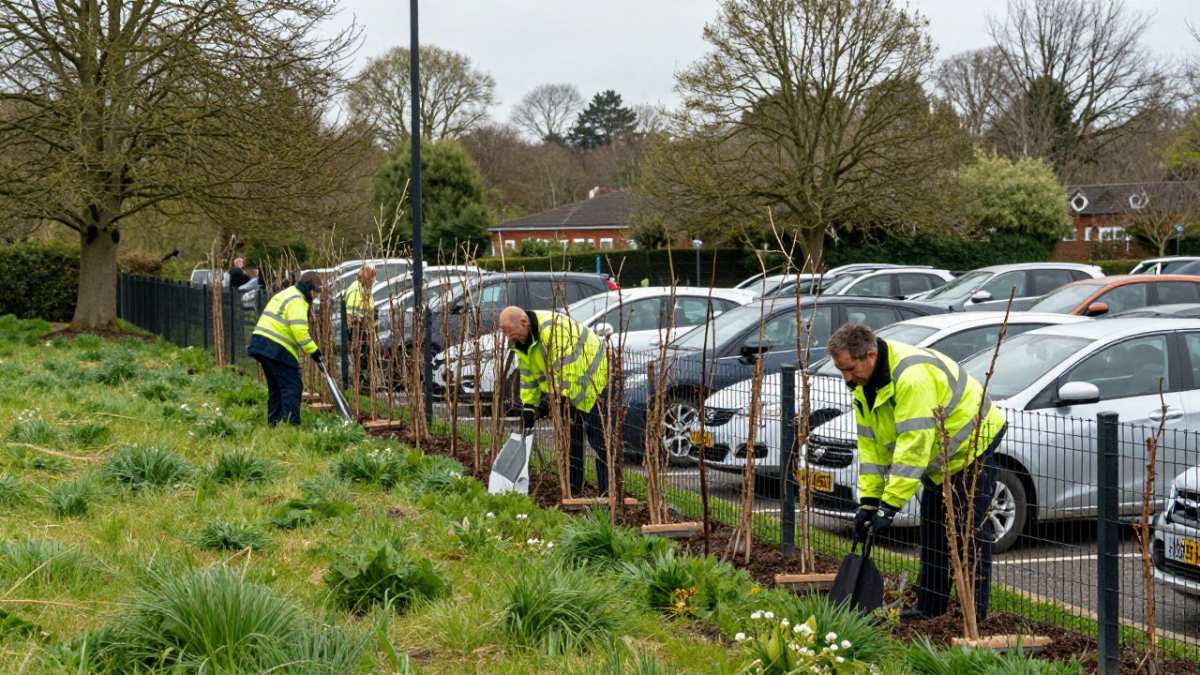
Wildlife-friendly commercial landscaping works when habitat is built into the edges and margins of a site rather than dropped into the middle of it. Boundaries, fence lines, embankments and the strips behind car park bays are where habitat survives because they are not walked on.
Trees, Hedgerows and Shrub Layers
A mixed native hedgerow is the single highest-value intervention on most commercial sites. It gives cover, nesting sites and a corridor between larger patches of green space. Hawthorn, blackthorn, hazel and field maple suit Greater Manchester conditions and cope with exposed, windswept boundaries.
Keep a shrub layer beneath mature trees rather than scalping it back each year. This is where insect communities overwinter and where birds shelter. If a roof edge is thick with moss, that is a separate maintenance question: our guide to the signs your roof needs moss removal explains when growth is cosmetic and when an inspection is sensible, and why roof coverings are never pressure washed.
Nesting Sites, Shelter and Deadwood
Standing deadwood and a modest log pile in a wild corner cost nothing and support insects, fungi and the birds that feed on them. Nesting boxes add value where mature trees are scarce. Face them away from prevailing wind and away from lighting columns, and leave them undisturbed through the nesting season.
Pollinator-Friendly Planting for Businesses: Beyond a Wildflower Strip
Pollinator-friendly planting for businesses works best as a sequence of flowering periods rather than one summer display. The goal is something in flower from early spring to late autumn, so pollinators are not starved between flushes.
A single wildflower strip is better than nothing, but it is a thin offering. Add spring-flowering shrubs and bulbs under trees, let a verge grow long into summer, and keep a late-flowering margin such as knapweed or field scabious for the end of the season. Native species are adapted to local conditions and need less water and fewer chemical inputs, as Heritage Landcare's native planting guidance sets out. Clump them together rather than scattering single plants, because pollinators forage more efficiently on grouped flowers.
Wildflower Areas and Meadow Management That Actually Get Cut
Wildflower meadow management is where most commercial schemes fail. The meadow looks wonderful in year one, then becomes rank grass and scrub because nobody agreed who cuts it, when, or with what. The fix is not more ecology advice; it is a phased plan, a written cutting specification and a monitoring routine that fits the grounds contract.
A Phased Implementation Sequence
Treat meadow creation as a multi-year project with clear stages, not a single sowing event.
Year one: baseline and preparation. Record the existing sward, soil depth and drainage. If the ground is nutrient-rich from years of mowing and fertiliser, the wildflowers will struggle against grass. Strip or invert the top layer in the target zone, or take a hay crop for a season to draw nutrients down. Do not sow into rank grass and hope.
Year one to two: establishment. Sow a native meadow mix suited to the soil and aspect, or plug-plant into prepared ground. Water only if establishment fails; overwatering favours grass. Expect a patchy first year. That is normal, not a failure.
Year two onwards: management. Cut once a year in late summer after seed has set, and remove the cuttings. Leaving cut grass in place smothers the wildflowers and feeds the rankest grasses. On a commercial site, cut in strips and leave one section standing each year so insects always have refuge.
Year three: review. Compare the meadow zone against the baseline record. If grass is still dominant, the nutrient problem was not solved and the cutting regime needs tightening.
A Bolton and Lancashire Seasonal Calendar
The North West's wetter, milder climate shifts the practical windows slightly compared with national guidance. A workable pattern for a Bolton or Greater Manchester site looks like this:
- March to April: inspect for nesting birds before any hedge or scrub work; check drainage in wet corners after winter.
- May to July: leave the meadow uncut; monitor flowering and pollinator activity.
- Late July to September: the main meadow cut, timed after seed set and before the autumn wet. Remove cuttings the same week.
- October to November: clear gutters before leaf fall peaks, so water flows away from planted margins; check that the meadow is not holding standing water.
- December to February: review the year's records, plan the next cut, and specify any remedial work in the grounds contract.
Watch out: if the meadow sits next to a formal lawn and the same mower goes straight from one to the other, you will get a striped, scalped mess. Specify the meadow cut as a separate operation with its own timing in the grounds contract.
