
Table of Contents
- What a commercial exterior cleaning maintenance plan should include
- Commercial gutter clearing, cladding and surface schedules
- Procurement brief, RAMS and COSHH for commercial cleaning
- Frequently Asked Questions
- Arrange a commercial site assessment
What a commercial exterior cleaning maintenance plan should include
A commercial exterior cleaning maintenance plan matches each surface to the right method, review frequency, access restrictions and completion evidence, with a named person responsible for sign-off. This guide from Refresh Revive Exterior Cleaning sets out what to specify and how to prove the work was done.
Match the method to the surface, risk and access. High pressure is not a default: render, coatings and cladding need a method compatible with the particular material and manufacturer guidance; suitable sound paving may be pressure washed after assessment. Cleaning restores appearance; it does not repair failed mortar, cracked render or damaged seals.
The entries below are illustrative examples, not a customer site record. Use the register as a template and replace the conditions, tasks and responsibilities after your site survey.
Asset / location | Condition | Task | Review trigger | Access restrictions | Responsible person | Completion evidence |
|---|---|---|---|---|---|---|
Gutters and downpipes, all elevations | Silt visible at outlets, staining on fascia | High-reach gutter vacuum and camera inspection | After heavy leaf fall; visible overflow | Working at height controls; ground protection | Site manager | Camera footage, before/after photos, signed sheet |
Main entrance and walkways | Algae film, leaf litter, chewing gum | Low-pressure wash and spot treatment | Slip report or monthly walk-round | Pedestrian segregation; out-of-hours preferred | Facilities coordinator | Photos, barrier removal sign-off |
Paving and forecourt | Moss in joints, oil spotting | Pressure washing plus stain treatment | Before winter; after spill incident | Vehicle movements; delivery windows | Property manager | Photos, defect report |
Commercial gutter clearing, cladding and surface schedules
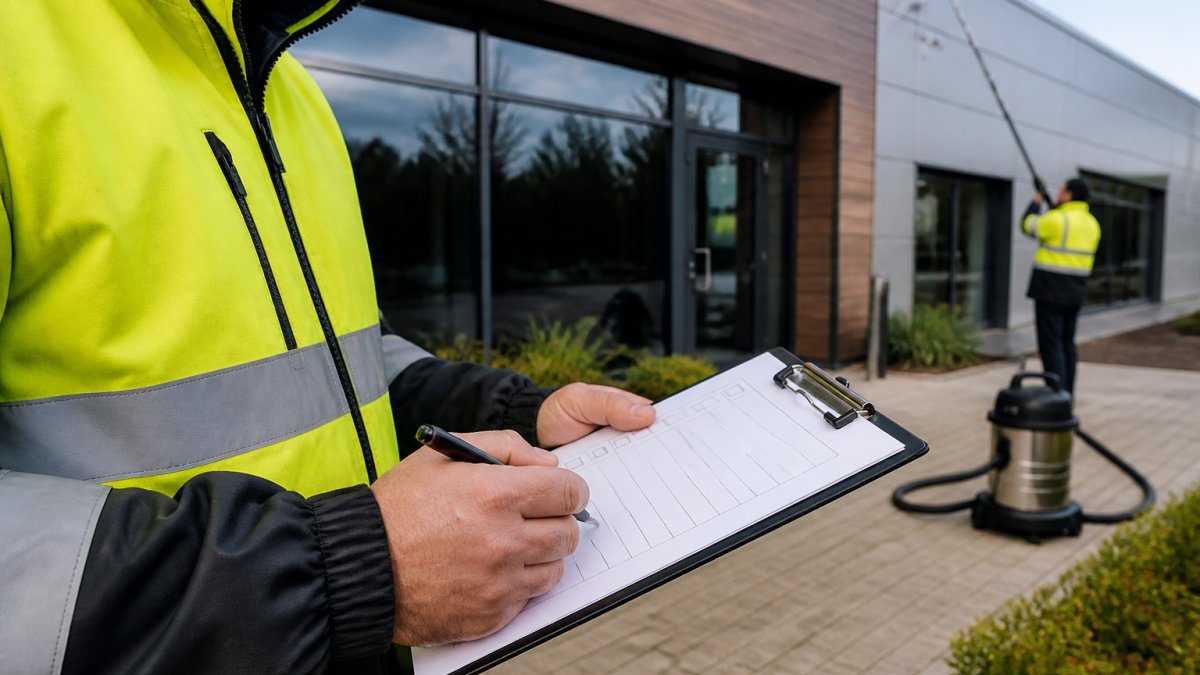
Prioritise gutters and outlets where drainage observations indicate a problem; site-specific risks determine the order of work. Commercial gutter clearing should combine high-reach vacuum equipment with camera inspection, so blockages and joint defects are recorded rather than assumed. Cladding finishes and seals need assessment before a compatible method is chosen. Paving and walkways also need checks for vulnerable surfaces and joints. Stain improvement depends on material and contamination; complete removal is not guaranteed.
Accessible glazing may suit pure-water pole cleaning from ground level. Reach, access, glass condition and the type of contamination affect the method and result. Where work at height is unavoidable, the starting point is to avoid it where reasonably practicable, as set out in HSE guidance on work at height. Our commercial exterior cleaning maintenance plan approach follows that hierarchy: reach poles and vacuums first, access equipment only when needed.
The table below is illustrative, not mandatory frequencies; set intervals from the site survey.
Season | Gutters and outlets | Entrances and walkways | Paving and forecourts | Cladding and render | Glazing |
|---|---|---|---|---|---|
Spring | Clear and inspect | Wash and treat algae | Moss removal before growth | Soft wash | Full clean |
Autumn | Clear after leaf fall | Grit and leaf clearance | Joint weed check | Inspect drainage paths | Clean |
Procurement brief, RAMS and COSHH for commercial cleaning
A procurement brief should state the site address, assets in scope, access, opening and delivery hours, pedestrian segregation, water supply and run-off management, and the evidence expected at handover. Ask every contractor for RAMS, COSHH information for any substances used, and insurance certificates verified directly with the insurer.