
Table of Contents
- What to Include in Commercial Exterior Maintenance Contracts
- Planned Preventative Maintenance Schedules for Commercial Sites
- COSHH Compliance for Exterior Cleaning Operations
- Commercial Gutter Cleaning Frequency and Standards
- Cost-Benefit Analysis: Outsourcing vs. In-House Maintenance
- Contract Negotiation: Key Terms and Service Level Agreements
- Sustainability and Biodiversity in Commercial Maintenance
- Conclusion
Last Updated: August 24, 2026
What to Include in Commercial Exterior Maintenance Contracts
A commercial exterior maintenance contract is a binding agreement between a property manager and a cleaning or grounds maintenance provider that outlines scope, frequency, standards, and responsibilities for keeping commercial buildings in good condition. The contract protects both parties by setting clear expectations about what work will be performed, how often, and to what standard.
The most important clauses define the scope of work precisely. Vague language like "general cleaning" leads to disputes. Instead, specify exactly which surfaces will be cleaned: roofs, gutters, render, driveways, car parks, graffiti removal, litter picking, or seasonal gritting.

A service level agreement (SLA) is non-negotiable. This section defines performance standards: how quickly the contractor responds to requests, what "clean" means for each surface type, and what happens if standards aren't met. For example, "gutters cleaned quarterly with debris removed and downpipes checked for blockages" is measurable. "Regular gutter maintenance" is not.
Insurance and liability clauses protect your property. The contractor must carry public liability insurance and, where relevant, employers' liability insurance. The contract should specify minimum coverage amounts and require proof of current insurance before work begins. Many property managers in the North West work with contractors like Refresh Revive Exterior Cleaning specifically because of their fully insured status and documented safety protocols.
Health and safety compliance belongs in the contract. This includes how the contractor will manage COSHH (Control of Substances Hazardous to Health) requirements, risk assessments for working at height, and adherence to HSE guidance. All chemical guidance must follow the product label and safety data sheet.
Payment terms and pricing structure should be clear: monthly, quarterly, or annual payments; what triggers price increases; and whether additional work beyond the contract scope has additional costs. Obtain a tailored quote rather than assuming standard rates.
Termination clauses protect both parties. Include notice periods (typically 30-90 days), grounds for immediate termination if safety standards are breached, and how disputes will be resolved.
Planned Preventative Maintenance Schedules for Commercial Sites
Planned preventative maintenance (PPM) is a proactive approach where work is scheduled at set intervals to prevent problems rather than responding to emergencies. For commercial exterior maintenance, PPM is far more cost-effective than reactive cleaning because it stops deterioration before it becomes serious.
Regular, lighter work prevents heavy, expensive work later. Moss and algae growth can be managed with regular low-pressure cleaning. Left untreated, they trap moisture against render or brick, leading to structural damage. Blocked gutters cause water to overflow and damage walls; quarterly cleaning prevents this (hse.gov.uk).
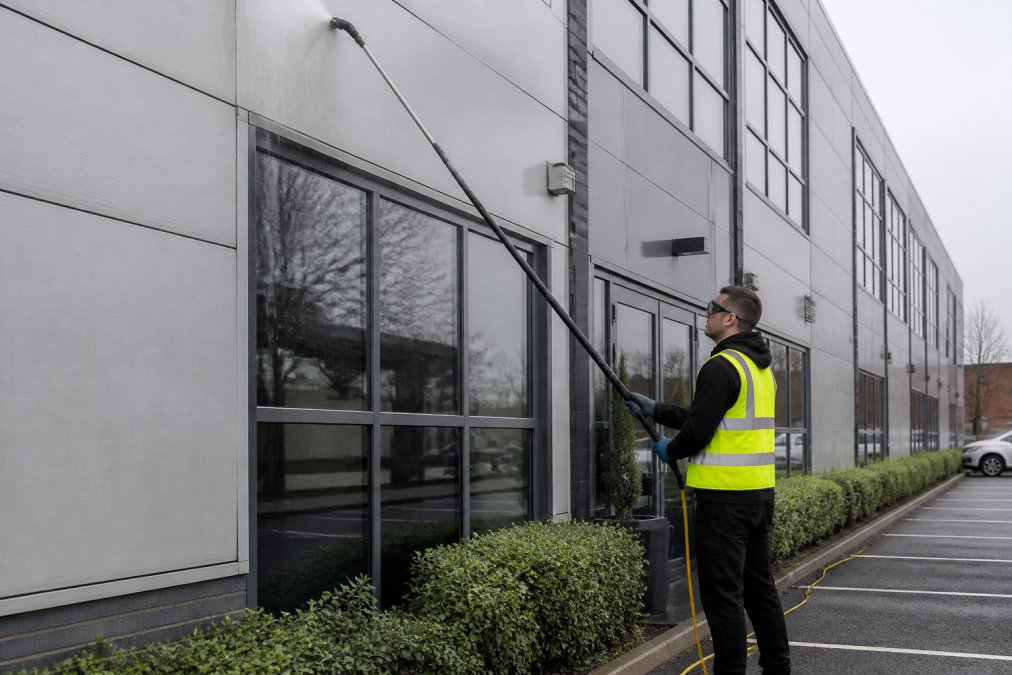
A typical annual PPM schedule for a commercial building includes:
- Spring (March-April): Winter debris clearance, gutter and downpipe cleaning, inspection of render and pointing for weather damage
- Summer (June-July): Moss and algae removal from roofs and hard surfaces, pressure washing where appropriate, inspection of sealants and caulking
- Autumn (September-October): Leaf and debris removal from gutters and roof spaces, drain checks, preparation for winter
- Winter (November-February): Gritting and snow clearance as needed, monitoring of gutters in heavy rain, inspection for ice damage
Frequency depends on site exposure and local conditions. A building in an exposed location with heavy rainfall needs gutter cleaning more often than one in a sheltered position. A north-facing roof accumulates moss faster because it stays damper longer.
Documentation is essential. Record every maintenance visit: what was done, surface condition, and any issues found. This creates a maintenance history that helps you plan future work and proves to insurers that you're managing the property responsibly. Before and after photographs are particularly valuable.
COSHH Compliance for Exterior Cleaning Operations
COSHH (Control of Substances Hazardous to Health) is a legal requirement under UK health and safety law (hse.gov.uk). Any commercial exterior maintenance contract must address how hazardous substances, cleaning chemicals, biocides, sealers, and other treatments will be managed safely.
The contractor must provide a COSHH assessment before work begins. This identifies which hazardous substances will be used, the risks they pose, and the control measures to prevent harm. For exterior cleaning, common hazardous substances include algaecides, fungicides, and surface cleaners.
Safety data sheets (SDS) must be available for every product used. These documents contain critical information: hazard classification, first aid measures, storage requirements, and disposal instructions. A competent contractor will provide SDS on request and explain how each product will be handled safely on your site.
Personal protective equipment (PPE) is only part of the control hierarchy. The law requires contractors to eliminate hazards first, substitute hazardous substances with safer alternatives second, and use engineering controls before relying on PPE. Low-pressure cleaning methods reduce the need for aggressive chemicals because water pressure does more of the work. This is why methods like those used by Refresh Revive Exterior Cleaning, which prioritise surface-specific, low-pressure techniques, align with COSHH principles.
Never instruct contractors to use improvised neutralisers, vinegar, bicarbonate of soda, acids, or alkalis after treatment. All chemical guidance must follow the product label and the contractor's risk assessment.
Your contract should require the contractor to:
- Provide current COSHH assessments and SDS for all products used
- Follow the manufacturer's instructions for dilution, application, and safety precautions
- Store chemicals safely on site, away from water sources and with secondary containment where required
- Dispose of chemical waste according to environmental and health regulations
- Inform you of any spillages or incidents immediately
- Train staff in safe handling of hazardous substances
Regular audits of the contractor's COSHH compliance protect your business from regulatory fines and ensure worker safety.
Commercial Gutter Cleaning Frequency and Standards
Gutters are critical infrastructure. They direct rainwater away from walls, roofs, and foundations. Blocked gutters cause water to overflow, damaging render, brickwork, and the building envelope. For commercial properties, gutter failure can lead to costly structural repairs and business interruption.
Most commercial buildings benefit from quarterly (four times per year) gutter cleaning (peer-reviewed research). This prevents accumulation of leaves, moss, and debris that traps moisture and becomes difficult to remove if left longer. Buildings surrounded by trees or in exposed locations may need cleaning more frequently; sheltered urban locations might manage with twice-yearly cleaning, though quarterly is safer.
The standard for commercial gutter cleaning includes:
- Complete removal of debris (leaves, moss, silt, and detritus)
- Flushing of downpipes to confirm flow and identify blockages
- Inspection of gutters for damage, rust, or deterioration
- Cleaning of gutter joints and seams where debris accumulates
- Inspection of fascia boards and soffit for damage or rot
- Photographic documentation of condition before and after
Low-pressure methods are appropriate for most gutters. High-pressure cleaning can damage older gutters or loosen joints. A competent contractor assesses each gutter's condition and chooses the safest method. Refresh Revive Exterior Cleaning's surface-specific approach means gutters are cleaned thoroughly without unnecessary force that could cause damage.
Gutters should be inspected for leaks, rust, and sagging during each cleaning. Minor issues caught early cost far less to repair than a gutter failure that allows water into the building. Document these inspections in your maintenance records.
Cost-Benefit Analysis: Outsourcing vs. In-House Maintenance
Many property managers face the decision: should we hire a contractor or manage exterior maintenance in-house? The answer depends on site complexity, frequency of work, and staff availability.
In-house maintenance appears cheaper on the surface, but this calculation often misses hidden costs. Staff time is expensive; paying someone to clean gutters quarterly or manage seasonal gritting adds up quickly. Equipment is capital-intensive: pressure washers, access equipment, safety harnesses, and specialist tools require initial investment and ongoing maintenance. Mistakes are costly: damage to render, roofs, or landscaping from improper technique leads to repair bills far exceeding the cost of professional work.
Health and safety compliance is a major hidden cost of in-house work. Your business is legally responsible for COSHH compliance, working-at-height safety, and insurance. If an employee is injured or a member of the public is harmed, your business carries the liability. Professional contractors carry their own insurance and are trained in safety protocols.
Outsourcing to a specialist contractor like Refresh Revive Exterior Cleaning transfers these risks and costs. You pay a fixed fee for defined work. The contractor manages COSHH compliance, insurance, staff training, and equipment. You receive documented before-and-after work, which is valuable for your maintenance records and insurance claims.
Outsourcing favours when:
- Your site requires work more than twice per year
- Work involves working at height or specialist equipment
- You lack staff with the skills or time to do the work safely
- Regulatory compliance is complex
- You want documented, guaranteed work to a defined standard