
Last Updated: 29 October 2026
Quick Summary
Harsh chemical cleaners are not safe for exterior stone walls, as strong acids, aggressive alkalis and even vinegar or lemon juice can etch, dull or permanently stain natural stone. Instead, use warm water with mild detergent, pH-neutral cleaners or stone soap for routine cleaning, and controlled soft washing or stone-safe biological treatments for algae and black spot lichen.
- Vinegar and lemon juice etch calcitic stones such as limestone and marble, while ammonia dulls the surface.
- Work in small sections with warm water and mild detergent, rinse thoroughly, and never let detergent dry on the surface.
- Stone soap is a preventive maintenance tool and will not remove established black spot or heavy algae.
- Soft washing relies on chemistry and dwell time at low pressure rather than force, which can strip mortar and roughen stone.
- DIY black spot products sold for driveways and patios are often too aggressive for natural stone walls.
Table of Contents
- Are Harsh Chemical Cleaners Safe for Exterior Stone Walls?
- A Quick Comparison of Stone Wall Cleaning Alternatives
- Warm Water and Mild Detergent: The Gentle First Step
- pH-Neutral Cleaners and Stone Soap Explained
- Soft Washing Stone Walls: Controlled, Low-Pressure Cleaning
- Removing Black Spots from Stone Without Harsh Chemicals
- Steam Cleaning for Sensitive Stonework
- Natural DIY Remedies: What Works and What Damages Stone
- Professional Stone Wall Restoration in Bolton
- Protecting Plants, Lawns and Surrounding Surfaces
- Request a Stone Wall Assessment from Refresh Revive
- Frequently Asked Questions
Are Harsh Chemical Cleaners Safe for Exterior Stone Walls?
No. Harsh chemical cleaners are not safe for exterior stone walls, because strong acids, aggressive alkalis and even some household "natural" remedies can etch, dull or permanently stain natural stone. The Use Natural Stone guidance on eco-friendly stone care is blunt about it: vinegar and lemon juice etch calcitic stones such as limestone and marble, while ammonia dulls the surface.
That matters because natural stone is a different material from concrete or asphalt. It is porous, often layered, and sometimes held together with lime mortar that softens under the wrong chemistry. A cleaner that brightens a concrete path can scar a sandstone wall for good.
Below, we compare the realistic alternatives to harsh chemical cleaners for exterior stone walls, with honest pros and cons for each. You will find out which methods genuinely remove dirt, algae and black spots, and which ones quietly make things worse.
A Quick Comparison of Stone Wall Cleaning Alternatives
The best alternative depends on what is on the wall. Loose dirt needs the gentlest approach. Biological growth needs treatment, not force. Here is how the main options stack up.
| Method | Best For | Risk to Stone | Effort |
|---|---|---|---|
| Warm water and mild detergent | Light, loose dirt | Very low | Low |
| pH-neutral cleaner or stone soap | Routine cleaning | Low | Low |
| Soft washing | Algae, grime, larger walls | Low when controlled | Professional |
| Steam cleaning | Sensitive or detailed stonework | Low to moderate | Professional |
| Vinegar or lemon juice | Nothing on natural stone | High, causes etching | Not advised |
| High-pressure washing | Not recommended for stone | High, can erode surface | Not advised |
The pattern is clear. The safest options are the least aggressive, and the most aggressive options are the ones most likely to cost you a repair.
Warm Water and Mild Detergent: The Gentle First Step
Warm water and a mild liquid detergent is the correct starting point for exterior stone walls carrying ordinary surface dirt. The Natural Stone Institute's stone care guidance lists this alongside neutral cleaners as a suitable option, and it is the first thing we try on lightly soiled walls.
The method is simple: warm water, a small amount of mild detergent, and a soft cloth or soft brush. Work in small sections, rinse thoroughly, and never let detergent dry on the surface. Leftover residue attracts dirt and can leave a dull film.
Where this approach falls short is anything biological. Green algae, black spot lichen and moss are not dirt, and detergent will not kill them. You might scrub the surface clean and find it green again within weeks. That is not a failure of effort, it is a failure of method.
Watch out: using a strong general-purpose household cleaner "just to be sure" undoes the point of starting gently. Many contain acids or bleach that attack stone and mortar.
pH-Neutral Cleaners and Stone Soap Explained
A pH-neutral cleaner is a cleaning product formulated to sit close to neutral on the pH scale, so it lifts dirt without the acidic or alkaline bite that damages natural stone. Stone soap is a related product made specifically for stone surfaces, and both appear in recognised stone-care guidance.
Why does neutrality matter? Natural stone, particularly limestone and marble, is calcitic. Acid reacts with it and eats into the surface, which shows up as a dull, etched patch that no amount of cleaning will fix. Alkaline products can be just as unkind to certain stones and to lime mortar joints.
Stone soap works by lifting dirt into a solution you then rinse away. It is excellent for maintenance cleaning on walls that are already in reasonable condition. What most guides miss is that stone soap is a preventive tool, not a restorative one. It will not remove established black spot or heavy algae.
For routine upkeep on a stone wall, a pH-neutral product used regularly will keep the surface cleaner for longer than an occasional harsh scrub. Pair it with a surface sealer and the wall stays cleaner still.
Soft Washing Stone Walls: Controlled, Low-Pressure Cleaning
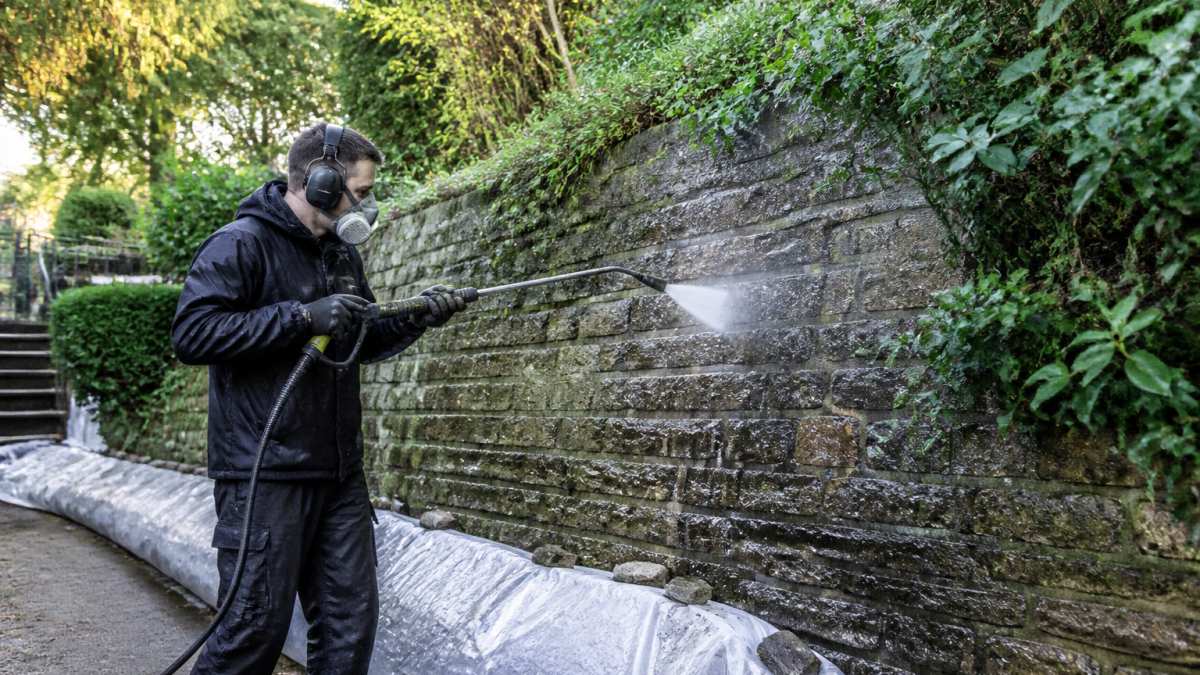
Soft washing stone walls is a low-pressure cleaning method that applies a surface-appropriate cleaning solution at gentle pressure, letting the treatment break down dirt and biological growth rather than blasting it off.
How Soft Washing Differs from Pressure Washing
Pressure washing relies on force. Soft washing relies on chemistry and dwell time, applied at low pressure. On stone, force is the problem: high-pressure jets can open up the surface, drive water into cracks, strip mortar and leave a permanently roughened finish.
If you want the full breakdown of how the two methods differ and which surfaces suit each, our guide to soft washing vs pressure washing covers the comparison in detail.
When Soft Washing Is the Right Choice
Soft washing suits larger stone walls, walls with green algae or organic staining, and properties where the surrounding planting needs protecting. It is also the sensible option for render and painted surfaces nearby. If you want to see how we apply it locally, our soft washing service across Bolton and the North West explains what a visit involves and how to request a quotation.
Removing Black Spots from Stone Without Harsh Chemicals
Removing black spots from stone without harsh chemicals is possible, but it needs patience and the right treatment rather than brute force. Those black spots are usually lichen, a living organism that anchors itself into the stone surface. Scrubbing at it with acid or a hard brush damages the stone before it touches the lichen.
The effective approach is a purpose-made, stone-safe biological treatment applied at low pressure and left to work over days or weeks. The treatment kills the organism, which then weathers away. It is slower than a harsh chemical wash, and it is far kinder to the wall.
Watch out: DIY black spot products sold for driveways and patios are often far too aggressive for natural stone walls. Check the label for stone suitability before you buy.
Steam Cleaning for Sensitive Stonework
Steam cleaning uses heat rather than harsh pressure or strong chemicals to loosen dirt and algae from sensitive stonework. Chiltern Surface's guide to cleaning exterior stone walls identifies steam as an option for delicate surfaces, and it can be a sensible choice for detailed or ornate stonework where water volume must stay low.
It is not a universal answer. The available guidance does not establish steam as suitable for every stone type or condition, and results depend heavily on the operator's control. Used carelessly, steam can still drive moisture into vulnerable stone.
