
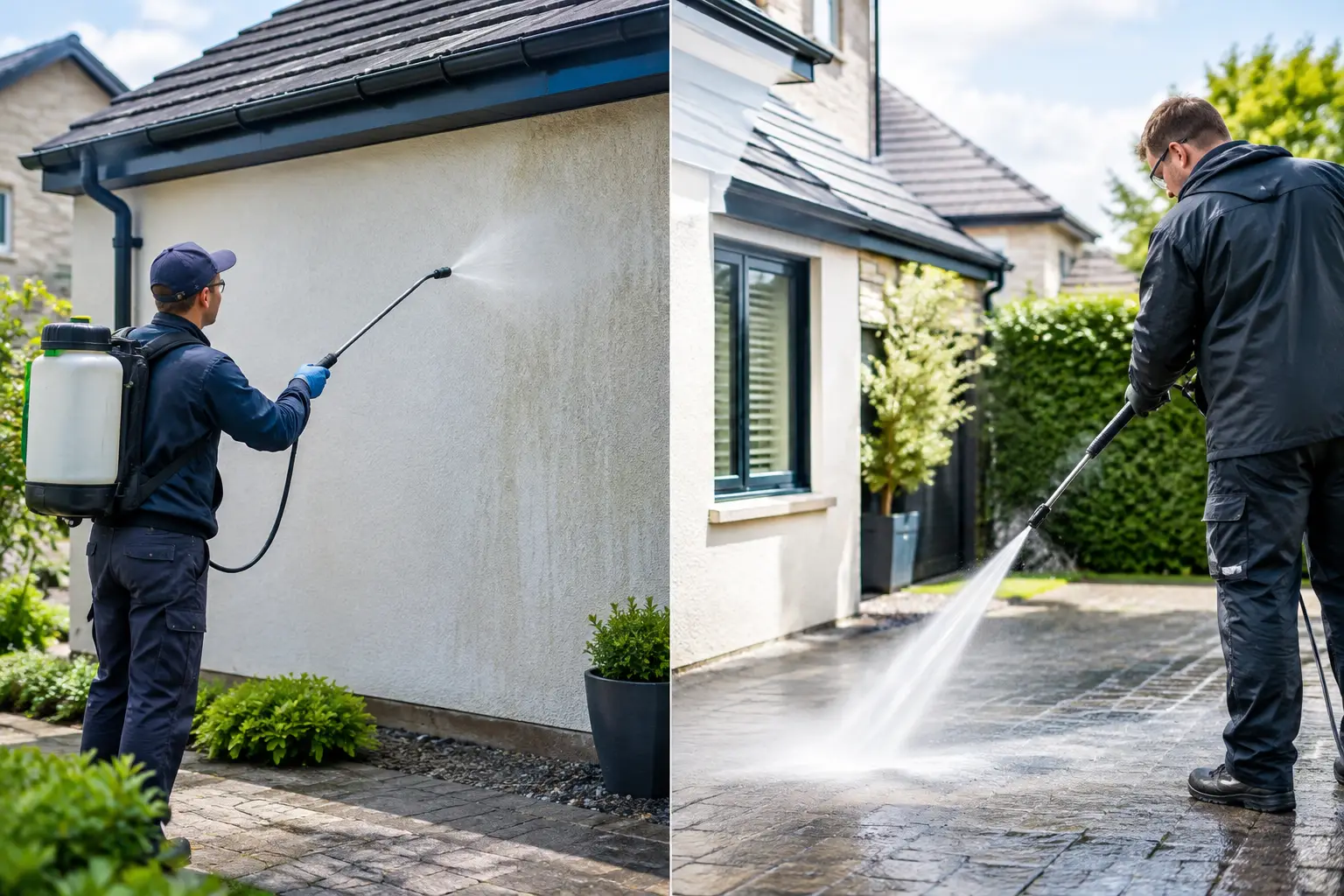
Green streaks, black spotting and dull patches can make otherwise sound render look neglected. When comparing render softwash versus jet washing, soft washing is usually the more suitable starting point for painted, silicone and K Rend surfaces because it treats the biological growth without relying on force to remove it. Jet washing may have a limited role in particular circumstances, but high pressure is not the default answer for a rendered wall.
The right choice depends on the render type, its age and condition, the cause of the staining, and whether there are cracks, loose areas, failed sealant or exposed edges around windows and doors. A proper assessment matters more than choosing the strongest-looking machine.
Why rendered walls become stained
Render is exposed to rain, shade, airborne dirt and changing temperatures year after year. Moisture can sit on cooler elevations, beneath gutters, around downpipes and under rooflines, creating conditions in which algae, moss and lichen can establish themselves. North-facing walls often show it first, although any wall with restricted sunlight or poor drainage can be affected.
The result is not always simply surface dirt. Green algae can spread across the face of the render, while red or black marks may be linked to biological growth, moisture patterns or staining that has settled into a textured finish. On pale render, even a relatively light film can noticeably change the appearance of the property.
Before cleaning, it is sensible to identify whether the issue is contamination alone or whether a building defect is contributing to it. A leaking gutter, overflowing hopper, damaged flashing or poor drainage can keep a wall wet. Cleaning may improve its appearance, but the staining can return if the source of excess moisture is left unaddressed.
Render softwash versus jet washing: the key difference
Soft washing uses a cleaning treatment applied at low pressure, followed by an appropriate rinse where required. The treatment is selected to deal with organic contamination such as algae, moss and lichen. Rather than blasting growth from the surface, the method is designed to break it down so it can be removed with controlled cleaning.
Jet washing, often used as a catch-all term for pressure washing, removes dirt through water pressure. It is highly effective on many hard exterior surfaces, including suitable driveways, patios and some paving. Render is different. Its finish can be textured, coated, thin in places or already weathered, so it does not always respond well to a forceful jet.
That does not mean every pressure washer will damage every rendered wall, nor does it mean soft washing suits every condition without inspection. It means the cleaning method should be matched to the surface, not chosen because it appears quicker.
Why high pressure can be a poor fit for render
Pressure can drive water into cracks, joints, vents and weak points around the wall. On compromised render, it may disturb loose material or worsen existing defects. It can also create uneven results by scouring a textured face, leaving a visibly cleaner patch beside an untreated or less affected area.
Coated render requires particular care. Silicone render and other modern finishes may be designed to shed water, but that does not make them suitable for aggressive washing. The wrong pressure, nozzle distance or technique can affect the surface appearance and may leave it more difficult to clean evenly in future.
There is also a practical issue: pressure alone does not always deal with the root of organic staining. A wall can look cleaner immediately after a powerful wash while traces of growth remain in pores and texture. Soft washing is intended to address that contamination rather than merely strip away the visible layer.
When soft washing is usually the better option
Soft washing is commonly the preferred approach where render is affected by algae, lichen, general weathering and biological staining. It is particularly worth considering for K Rend, silicone render, coloured render and painted exterior walls, where preserving a consistent finish is as important as improving cleanliness.
A careful softwash process normally begins with checking the surface. This includes looking for obvious cracks, hollow or loose areas, damaged pointing nearby, open vents, failed mastic and sensitive features such as external electrics, planting, doors and windows. The application and rinse method can then be adjusted to the wall rather than applied as a one-size-fits-all service.
Some staining may take time to release fully after treatment, especially where lichen has become established or where the render has a deeper texture. That is not necessarily a sign that the process has failed. Trying to force an instant result with more pressure can be the wrong response on a delicate or weathered finish.
Situations where controlled pressure may be considered
There are cases where carefully controlled pressure can form part of a wider render-cleaning process. It may be used for a low-pressure rinse after treatment, or on certain robust sections where the surface condition has been checked. The distinction is important: controlled pressure is not the same as directing a high-powered jet at the wall from close range.
The equipment itself does not decide whether a job is appropriate. Even commercial pressure-washing equipment capable of high output must be used at the correct setting, distance and angle, or not used at all on the rendered area. Professional judgement is knowing when treatment and a gentle rinse are enough.
If the wall has active cracking, flaking paint, unstable render, visible water ingress or defects around openings, cleaning may need to wait until repairs are completed. No cleaning method can make failing render structurally sound.