
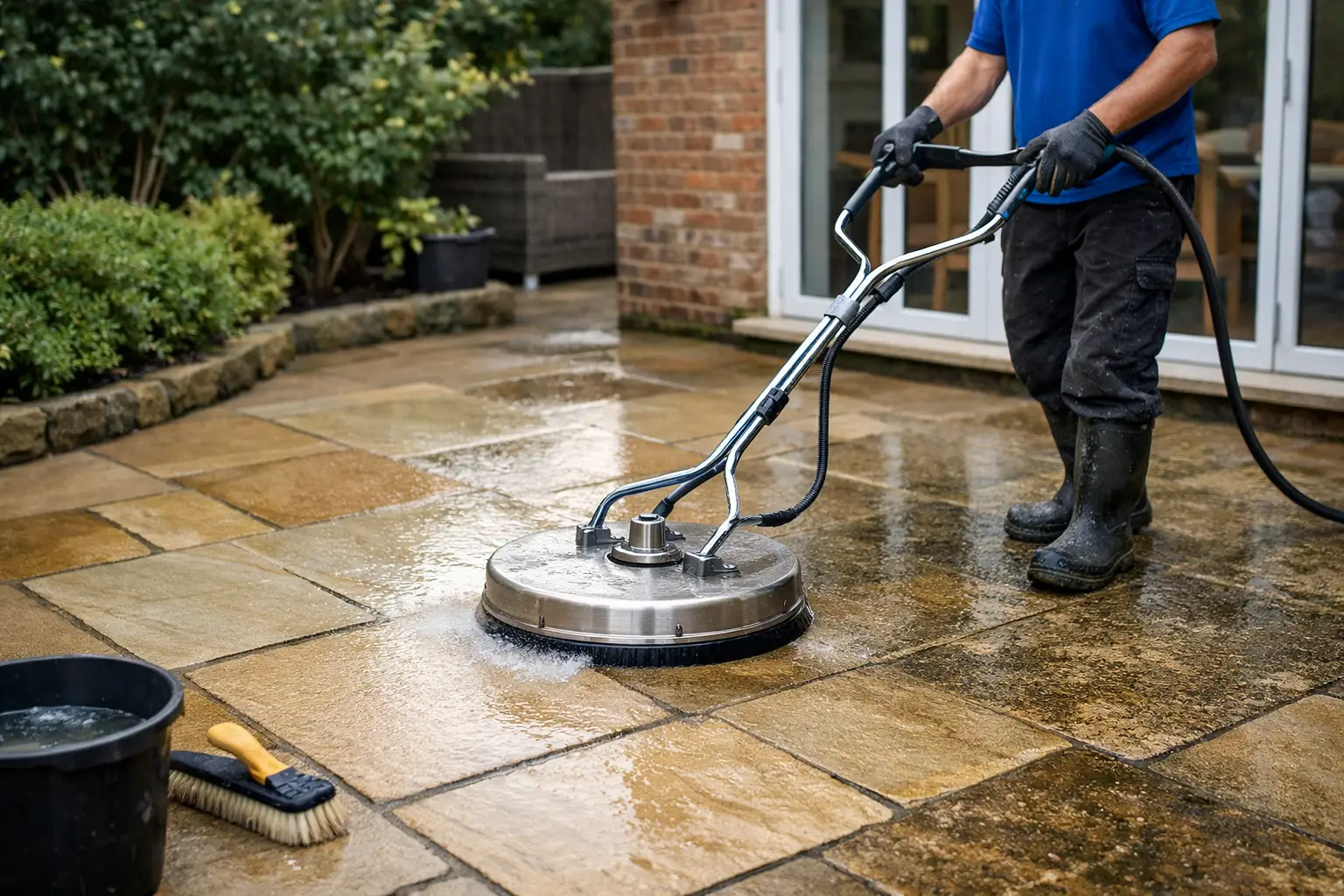
A sandstone patio can look tired long before the stone itself has reached the end of its life. Green algae, black spot, moss, lichen and everyday grime can mask the natural variation that makes sandstone so appealing. Effective sandstone patio cleaning is not simply a matter of using the highest pressure available. The method needs to suit the stone, its condition and the contamination present.
For homeowners, landlords and property managers, the aim is usually straightforward: restore a cleaner, safer-looking outdoor area without taking unnecessary risks with a naturally porous surface. That begins with an assessment rather than a one-size-fits-all approach.
How to clean a sandstone patio safely
Sandstone should be assessed before cleaning because natural stone varies in hardness, porosity and condition. Loose debris should be removed first, followed by a controlled cleaning method suitable for the stone. Excessive pressure should be avoided where it could damage the surface or pointing, and persistent algae, lichen or black spot may require an appropriate treatment rather than simply increasing the pressure.
Why sandstone needs a considered cleaning method
Sandstone is a natural stone, not a uniform manufactured slab. Its density, texture, colour and porosity can vary not only between different patios, but sometimes across the same paved area. Some flags are relatively dense and resilient; others are softer, more open-textured or already weathered.
That variation matters when selecting a cleaning method. Excessive pressure, poor technique or unsuitable products can roughen the surface, disturb fragile areas or leave it looking uneven. The jointing also deserves attention. If it is loose, worn or missing in places, aggressive cleaning may make the problem more obvious.
A professional assessment looks beyond the surface dirt. It considers whether the patio has settled, whether the joints are stable, how water drains away, and whether dark marks are biological growth, staining or simply natural colour variation in the stone. Cleaning can make a significant difference, but it cannot repair cracked flags, reverse erosion or remove every deep-set mineral mark.
The common problems on sandstone patios
The North West's wet weather and shaded gardens create favourable conditions for organic growth. A patio beneath trees, beside a north-facing wall or close to planting may remain damp for longer, allowing algae and moss to return more readily than they would in an open, sunny space.
Green algae often creates the slippery film people notice first. Moss can establish itself around edges and joints, while lichen forms more stubborn pale or dark patches that may need additional treatment. Black spot is another frequent concern. It can appear as small dark marks or widespread staining, and it often clings more firmly than ordinary dirt.
There are also stains that cleaning alone may not fully resolve. Rust marks from metal furniture, oil from a barbecue, leaf tannins, paint, mortar residue and efflorescence each need to be identified before treatment. Applying a strong cleaner without knowing the cause can disappoint at best and create a new problem at worst.
How professional sandstone patio cleaning works
The best approach depends on what is on the paving and how the stone responds during assessment. Refresh & Revive Exterior Cleaning, based in Bolton, selects controlled-pressure or low-pressure cleaning methods according to the surface and its condition, rather than treating all patios in the same way.
Initial inspection and preparation
Before cleaning starts, the patio should be inspected for loose flags, cracked edges, failing joints and areas where the stone has become particularly soft or flaky. Furniture, pots and movable items are cleared where possible, while surrounding features need sensible protection.
The drainage route is also worth checking. Cleaning releases dirt, moss and debris, and those materials need to be managed rather than pushed towards gullies that are already struggling to cope. A patio that stays wet because of poor drainage may look cleaner after treatment, but the underlying damp conditions can encourage fresh growth.
Treating biological growth
Where algae, moss, lichen or black spot is present, a suitable low-pressure treatment may be used to address the biological contamination. This can be particularly helpful on delicate, uneven or heavily colonised sandstone, where relying on pressure alone may be less appropriate.
Treatment needs time to work, and the visible outcome can vary with the severity of the growth, the age of the staining and the stone's porosity. Some deeply established marks may lighten substantially rather than disappear completely. A measured expectation is better than a promise no natural surface can reliably meet.
Controlled cleaning of the stone
Once the contamination has been assessed and treated as needed, controlled cleaning lifts surface dirt and rinses away loosened growth. Professional equipment can be effective, but the result depends on pressure selection, water flow, distance from the surface and operator technique.
This is why hiring a high-powered machine is not always the same as choosing the right solution. A patio can look temporarily bright after an overly harsh clean, yet the stone may be left with a rougher texture that holds dirt and moisture more readily. The goal is a clean, even finish that respects the material rather than chasing an artificial, freshly manufactured appearance.
Attention to joints and edges
Patio joints often collect soil, weeds and moss. Cleaning can expose gaps that were already present, particularly on older paving. That is not necessarily a sign that cleaning has caused the issue, but it does mean the patio may need further attention once it is dry.
Edges, steps and threshold areas also need careful handling. These sections may have softer mortar, narrow drainage channels or nearby render and timber that should not be treated in the same way as the stone itself.