

Last Updated: November 7, 2026
Quick Summary
Replace old plastic guttering when faults are repeated rather than isolated, such as cracked joints, loose brackets and overflow along a whole run. If the system is past roughly 20 years old and the plastic feels chalky or brittle, repairs will only last a season or two, so replacement is the honest answer.
- One blocked section or a single loose bracket is a maintenance job, not a replacement.
- Press a gutter length gently: if it cracks or feels chalky, the plastic has degraded.
- Three or more faults on the same run usually means the run is failing as a system.
- A repair on 20-year-old plastic often lasts a season or two at most.
- Mixing profiles from different manufacturers is the most common cause of drips at new joints.
Table of Contents
- How Long Does uPVC Guttering Last?
- Signs Guttering Needs Replacing
- What Age, Weathering and UV Exposure Do to Plastic Guttering
- Repair or Replace Guttering: How to Decide
- Gutter Inspection With Camera: Seeing the Damage You Cannot
- What Happens If You Delay Replacing Old Guttering
- Replacement Choices That Avoid Compatibility Problems
- Book a Gutter Inspection Before You Commit to Replacement
- Frequently Asked Questions
How Long Does uPVC Guttering Last?
Plastic guttering lifespan varies considerably depending on conditions and maintenance. If your gutters are approaching that age, it is time to start watching for the signs that tell you when to replace old plastic guttering.
Age alone does not decide it. Condition does. A 22-year-old gutter that still sheds water cleanly may have years left. A 16-year-old gutter with cracked joints and sagging brackets is already failing.
At Refresh Revive Exterior Cleaning, we clear and inspect guttering across Bolton, Bury, Wigan, Chorley and the wider North West. Homeowners often wait for a visible leak before acting, by which point water may already have been affecting the fascia boards for some time.
Below, we will show you exactly how to judge your own gutters, when repair makes sense, and when replacement is the honest answer.
Why Lifespan Estimates Vary So Much
The range is wide because the number depends on far more than the plastic itself.
- Weather exposure: South-facing runs bake in UV light all summer.
- Roof type: Moss and grit from a tired roof wash into the gutter and sit there.
- Fall and fitting quality: Poor falls trap standing water that never drains.
- Maintenance history: Gutters cleared twice a year last longer than gutters cleared once a decade.
- Tree cover: Properties near mature trees collect leaves fast.
A sheltered, well-cleared gutter can outlast an exposed, neglected one considerably. That is why a single number is hard to give for any house without looking at it first.
Signs Guttering Needs Replacing
The clearest sign is repeated failure in the same places. One blocked section is a maintenance job. Cracked joints, loose brackets and overflow along the whole run point to a system at the end of its life.
A common mistake is patching the same joint every autumn. If you are sealing the same spot year after year, the plastic around it has gone brittle and the seal is no longer the real problem.
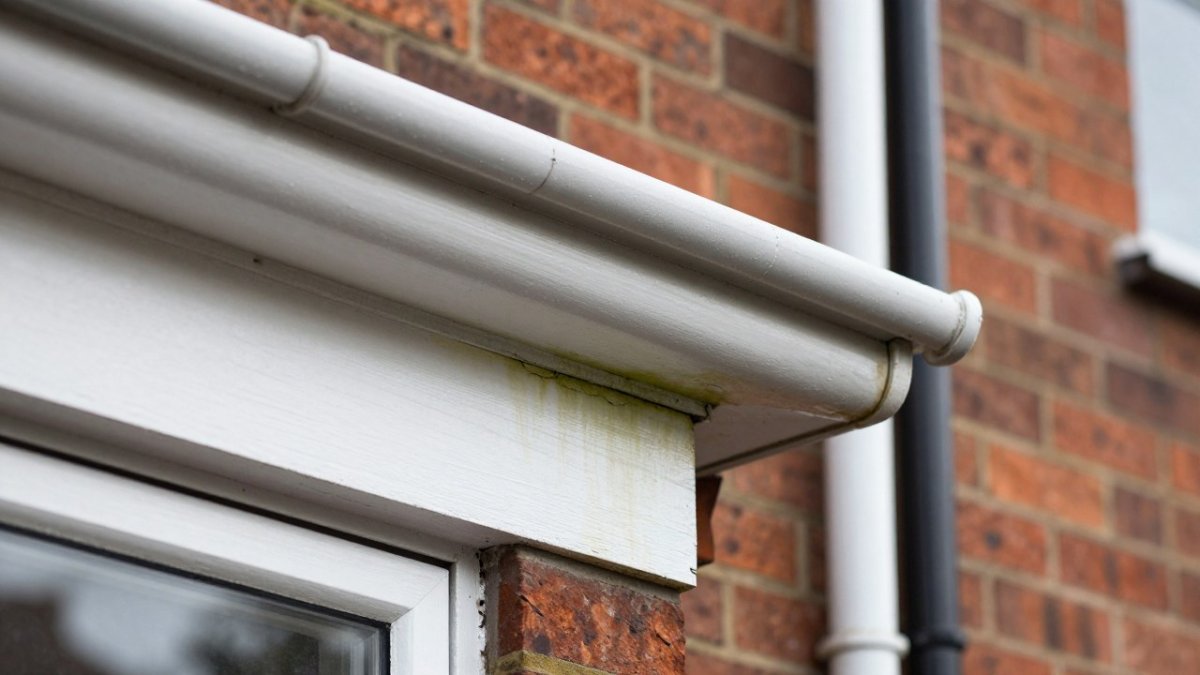
Here are the warning signs we check on every visit:
- Cracks or splits in the gutter lengths
- Damp patches on the fascia board behind the gutter
- Joints that pull apart or drip in heavy rain
- Brackets that have come loose or rusted through
- Gutters that sag between fixings
- Overflow at the outlet or downpipe
- Water staining down the brickwork
- Plants or moss growing out of the gutter itself
Cracks, Leaks and Failing Joints
Small cracks spread. Plastic that has spent two decades in sun and frost loses its flexibility, so a hairline split opens up with the first cold snap. Rubber seals harden and shrink, and that is when failing joints start to drip.
Watch out: a leak that only shows in heavy rain is still a leak. Water is finding its way behind the gutter and onto the fascia, and that is where rot begins.
What Age, Weathering and UV Exposure Do to Plastic Guttering
Sunlight is the quiet killer of uPVC guttering. UV exposure breaks down the plastic over time, and the gutter turns chalky, then brittle. Once it reaches that stage, it cracks instead of flexing.
Temperature changes do the rest. Gutter lengths expand in summer and contract in winter. After enough cycles, the movement works joints loose and pulls fixings out of the fascia.
Plastic ages faster when exposed to repeated wet and dry cycles and strong sun than in a mild, steady climate.
You cannot reverse this. Once the plastic has gone brittle, no sealant or paint brings it back. The material itself has changed.
Repair or Replace Guttering: How to Decide
Repair is the right call when damage is localised and the plastic still has flexibility. The honest test is not how bad the damage looks today, but whether a repair will still be holding in two winters' time.
Use this decision process, working through it in order:
- How old is the system? If it is past roughly 20 years and you have had more than one fault in the last two years, lean towards replacement. Age alone is not decisive, but it shifts the odds.
- How many separate faults are there? One blocked section or a single loose bracket is a maintenance job. Three or more faults on the same run usually means the run is failing as a system, not as isolated points.
- Is the plastic still flexible? Press a gutter length gently. If it flexes and springs back, a joint repair can last. If it cracks or feels chalky, the material has degraded and any repair is temporary.
- Are matching parts available? Gutter profiles differ between manufacturers and older profiles are often discontinued. If you cannot source the correct joint, outlet or bracket, a repair becomes a bodge.
- Is the leak recurring in the same place? A joint that has been sealed three autumns running is telling you the seal is no longer the problem, the plastic around it has gone.
- Is the fascia sound? If water has already softened the fascia board, fix the gutter and the fascia together. Replacing a gutter onto rotten timber just moves the failure.
Use this simple decision guide:
| What you are seeing | Best course of action | Why |
|---|---|---|
| One blocked section or a single loose bracket | Clear and repair | Localised damage, rest of the run is sound |
| One failed joint on otherwise flexible gutter | Replace the joint and seal | Cheap fix if the plastic still flexes |
| Repeated cracks in the same run | Replace that run | Brittle plastic will keep failing |
| Sagging across several lengths | Replace brackets and check the fall | Fixings have given way |
| Leaks along most of the system | Full replacement | Repair will not hold on aged plastic |
| Mismatched parts and no spares available | Full replacement | Compatibility problems make repair unreliable |
| Damp or rot in the fascia behind the gutter | Replace gutter and repair fascia together | Water ingress has already spread |
One honest limitation: a repair on 20-year-old plastic often lasts a season or two at most. If the gutter is already at the end of its life, you are spending money twice. A partial replacement, renewing one failed run while keeping sound runs, is often the sensible middle path, provided the new sections match the existing profile.
If you are weighing up a safe approach to clearing before you decide, our guide on cleaning gutters without damaging roof tiles covers the tools and methods that protect the roof line while you assess the damage.
Gutter Inspection With Camera: Seeing the Damage You Cannot
You cannot judge a gutter from the ground. A camera inspection shows the inside of the run, the state of the joints and the fall of the gutter, without anyone climbing a ladder.
A high-reach gutter vacuum with a camera on the pole can clear debris and show the condition of the gutter at the same time.
What most guides miss is that the inside tells a different story to the outside. A gutter can look fine from the pavement while the base is cracked and holding water. The camera finds that before it becomes a damp patch on your ceiling.
If overflow is your main concern, our article on why gutters overflow explains how to tell a blockage from a fall problem or a failed joint.
