

Last Updated: 16 November 2026
Quick Summary
Professional gutter vacuum cleaning removes leaves, moss and fine silt from your gutters from the ground, so there is no ladder needed. It clears the channel more thoroughly than hand methods and leaves far less mess on paths, drives and planting, making it especially useful for tall or hard-to-reach rooflines.
- Operators work from the ground using a telescopic wand, so ladder risk is removed.
- Vacuum systems lift fine silt out, while hand clearing often pushes it further along.
- Debris goes into a collection tank, leaving far less mess to sweep up afterwards.
- Most gutters benefit from clearing at least once a year, ideally in late autumn.
- Pairing cleaning with camera inspection helps spot sagging, loose brackets or cracked joints early.
Table of Contents
- What Professional Gutter Vacuum Cleaning Involves
- The Main Benefits of Professional Gutter Vacuum Cleaning
- Gutter Vacuum vs Manual Cleaning: How They Compare
- Signs Your Gutters Need Cleaning Now
- How Often Gutters Should Be Cleaned
- How Camera Inspection Adds Value to Gutter Cleaning
- Pros, Cons and Limitations of Gutter Vacuum Cleaning
- What Neglected Gutters Cost Your Property
- Booking Your Gutter Clearance in Bolton and Beyond
- Frequently Asked Questions
What Professional Gutter Vacuum Cleaning Involves
Professional gutter vacuum cleaning uses a high-reach vacuum system to remove leaves, moss, silt and other debris from your gutters without you having to climb a ladder. The operator works from the ground, guiding a telescopic wand along the guttering while the unit draws debris into a collection tank.
The process usually begins with a visual check of the property, including the gutter line, downpipes, fascias and any visible staining. Access and surroundings are assessed before work starts, because not every property suits every method. Where a vacuum system is appropriate, the wand is extended to reach the gutter run and debris is lifted out in sections.
Many homeowners ask how this differs from a simple tidy-up. A standard clear by hand often pushes fine silt further along the channel or leaves residue behind. A vacuum system removes the material itself, which tends to leave a cleaner channel that drains properly.
The Main Benefits of Professional Gutter Vacuum Cleaning
The most immediate benefit is safety. Working from the ground removes the risk of ladder falls, which is a serious concern for anyone working at height (Working at height). For homeowners, this also means you do not need to attempt the job yourself. In Bolton and the surrounding area, many properties have tall rooflines, conservatories or awkward access over extensions, and a ladder-based clear can be slow and risky. A high-reach vacuum system lets the operator stand safely on the ground while still reaching the gutter run.
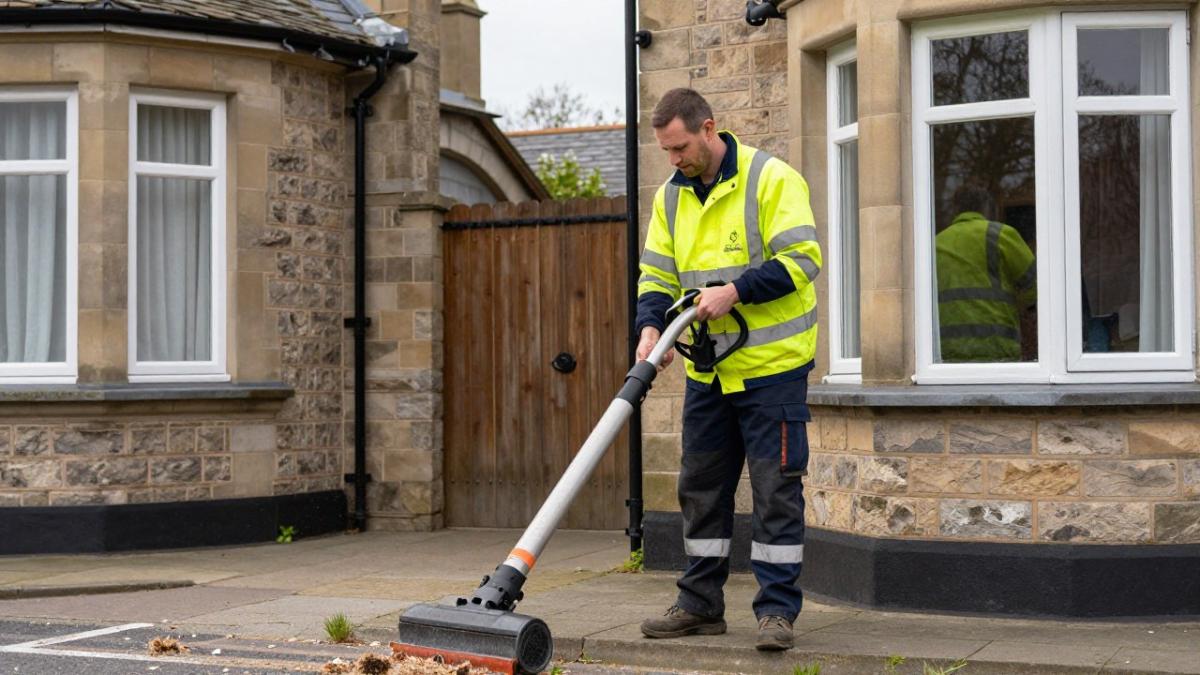
Thoroughness is the second advantage. A well-run vacuum system clears fine silt and moss that hand methods often miss. Hand clearing with a scoop or trowel tends to push wet silt further along the channel, and it can leave a thin layer that hardens and blocks the outlet over time. The vacuum lifts the material out, so the channel is left cleaner and water can flow freely to the downpipe. This matters most on properties with mature trees or heavy roof moss, where fine debris builds up quickly.
Mess is also reduced. Debris goes straight into a collection unit rather than onto your patio, drive or flower beds, so there is less to sweep up afterwards. This is particularly useful on properties with block-paved drives, gravel or planted borders beneath the gutter line, where a traditional clear can leave a scattering of leaves and moss that is difficult to remove.
Speed is another factor. A trained operator can often clear a standard run more quickly than a hand-based approach, especially on longer or higher sections. That speed does not come at the expense of care: the operator can adjust suction and use camera inspection to check that the downpipe is clear and that no joints have failed.
A less obvious benefit is that vacuum cleaning pairs well with a condition check. Because the operator is working methodically along the gutter run, it is easier to spot sagging sections, loose brackets or cracked joints at the same time. That early warning can prevent a small repair becoming a larger problem. For a deeper look at how these benefits fit into a regular maintenance plan, see our guide on how to clear blocked gutters safely at home, which explains the warning signs and when a professional visit makes more sense.
Gutter Vacuum vs Manual Cleaning: How They Compare
Both methods have a place, so it helps to compare them on the points that matter most for your property.
| Factor | Gutter Vacuum | Manual Cleaning |
|---|---|---|
| Ladder use | Usually not needed | Usually required |
| Fine silt removal | Strong | Variable |
| Mess left behind | Minimal | Often significant |
| Speed on standard runs | Typically faster | Slower |
| Best for | Multi-storey and hard-to-reach runs | Small, accessible properties |
Manual cleaning can work well on a single-storey home with easy access, particularly if the debris is mostly loose leaves. Vacuum cleaning tends to suit higher roofs, mixed debris and properties where working at height is a concern. Neither approach suits every situation, and a proper assessment before work begins is the best way to choose.
Signs Your Gutters Need Cleaning Now
Several warning signs suggest your gutters are overdue for attention. Overflow during rain is the clearest one, particularly water spilling over the edge rather than into the downpipe. Look for staining or streaks on the wall beneath the gutter, which often indicates water running down the face of the property.
Other signs include plant growth in the gutter, sagging sections, and a musty smell or damp patches near the eaves. If you see water pooling in the channel after rain has stopped, the outlet is likely partly blocked.
Overflowing gutters usually point to a blockage, a fall problem or a failed joint. Our autumn inspection checklist lists the warning signs to check for in your own gutters. If you want to understand which one applies to your property, read our guide on why gutters overflow and what to do about it. Spotting these signs early can prevent a small blockage becoming a larger repair.
How Often Gutters Should Be Cleaned
There is no single answer that suits every property, but most gutters in Bolton and the surrounding area benefit from clearing at least once a year. The best time is usually late autumn, after the majority of leaves have fallen but before winter rain and frost put the system under pressure. A second check in spring can catch moss and debris that accumulated over winter.
Several local factors push that baseline up or down. Properties near mature trees, oak, sycamore, ash and beech are common in Bolton, Bury and Chorley, often need clearing twice a year, sometimes more if the roof is large or the gutters are shallow. Homes with heavy moss on the roof will also see granules and moss fragments wash into the gutter, so a roof moss removal or soft wash may be worth considering alongside gutter clearing. Bungalows and properties with long, single-storey gutter runs can sometimes go longer between visits, while tall or complex rooflines tend to collect debris in specific sections and may need targeted checks.
A practical way to set a schedule is to note when the gutters were last cleared and then watch for early warning signs: water dripping from a joint, birds pecking at the gutter line, or a slight sag. If you see any of these before the annual date, bring the visit forward. For a more detailed look at how local conditions affect timing, see our guide to gutter cleaning in Cheshire, which covers the seasonal patterns in that area.
For commercial premises, offices, retail units, schools and care homes, a written maintenance plan with fixed inspection dates is usually more reliable than a reactive approach. Facilities managers often find that two visits a year, one in late autumn and one in early spring, keep the system clear and provide a paper trail for compliance and insurance purposes. Refresh Revive can advise on a suitable schedule as part of a quote.
How Camera Inspection Adds Value to Gutter Cleaning
Camera inspection lets the operator look inside the gutter and downpipe before, during and after cleaning. This shows where a blockage actually sits, whether a joint has separated, and whether a section is sagging or cracked. Instead of guessing, you get a clear picture of the system's condition.
Inspection also helps you decide what to do next. If the camera shows a minor build-up, a vacuum clear may be enough. If it reveals a failed joint or damaged section, that information lets you plan a repair rather than repeat cleaning that will not solve the underlying problem.
