
Last Updated: 6 November 2026
Quick Summary
The best gutter guards for heavy rainfall are those with a large open area that lets water through fast while still holding back leaves and moss. Micro-mesh is most often recommended, but only on roofs kept free of heavy moss, and guards cannot fix gutters that are undersized or badly sloped.
- A guard that filters out every leaf but holds a film of water is worse than no guard in a downpour.
- Driving rain can overshoot the gutter entirely, so overflow in storms often has nothing to do with debris.
- Micro-mesh under a heavy moss load without roof treatment will clog faster than an open gutter would have blocked.
- Foam guards hold moisture against the gutter and degrade quickly in a wet UK climate.
- Check the open area and fixing method before the marketing claims when buying a guard.
Table of Contents
- What the Best Gutter Guards for Heavy Rainfall Actually Do
- Do Gutter Guards Work When Rain Comes Sideways?
- Mesh Gutter Guards and the Fine Debris Problem
- Gutter Guard Types Compared: Mesh, Micro-Mesh, Brush and Foam
- Gutter Overflow in Heavy Rain: Why Guards Alone Won't Fix It
- Materials, Lifespan and Weather Resistance in a Wet Climate
- Fitting Guards to UK Gutter Profiles and Roof Types
- Gutter Cleaning and Maintenance: What Guards Don't Remove
- Getting Your Gutters Assessed Before You Buy
- Frequently Asked Questions
What the Best Gutter Guards for Heavy Rainfall Actually Do
The best gutter guards for heavy rainfall are not the ones that block the most debris. They are the ones that let the most water through while still keeping leaves and moss out. That distinction matters, and it is where most buying advice goes wrong. At Refresh Revive Exterior Cleaning, we clear gutters across Bolton and the wider North West, and we see the same pattern on roof after roof: a guard fitted for the wrong reason, then blamed when the gutter still overflows.
A gutter guard is a cover fitted over the open channel of a gutter to stop debris entering while allowing rainwater to drain away. Simple enough. But a guard that filters out every leaf and then holds a film of water across its surface is worse than no guard at all in a downpour.
Three things decide whether a guard copes with heavy rain:
- Open area. How much of the surface actually lets water through.
- Gutter sizing. A guard cannot fix a gutter that is too small for the roof area draining into it.
- Maintenance. Every guard needs occasional clearing, whatever the packaging says.
This Old House review of gutter guards for heavy rain makes the point that guards handle heavy rainfall when paired with properly sized gutters and downpipes. The system matters as much as the product.
Do Gutter Guards Work When Rain Comes Sideways?
Partly. Gutter guards work well against leaves falling from above, but driving rain is a different problem. Water travelling at an angle can overshoot the gutter entirely, land on the fascia, or run behind the guard and into the channel as normal.
This is why gutter overflow in heavy rain often has nothing to do with debris. If your gutters spill during a storm but run clear in light rain, the likely causes are:
- Water volume exceeding the capacity of the gutter and downpipe
- A fall problem, where the gutter does not slope towards the outlet
- A failed joint or bracket letting water escape behind the run
- Rain driving against the roof pitch and overshooting the gutter line
A guard cannot solve any of those. What most guides miss is that guards are a debris strategy, not a drainage strategy. If your gutters overflow in storms, the fix starts with diagnosis, not a trip to the DIY shop. Our guide on why gutters overflow walks through how to tell a blockage from a fall problem or a failed joint.
Mesh Gutter Guards and the Fine Debris Problem
Mesh gutter guards are the most common type fitted on UK homes, and for good reason. A stainless steel or aluminium mesh sits across the gutter channel and lets water through while holding back leaves. Micro-mesh goes finer still, with a tighter weave that also catches moss spores, lichen fragments and the grit that washes off tiles.
That finer weave is where the trade-off lives. Good Housekeeping's guidance on gutter guard materials notes that plastic guards suit dry climates with little rain, which tells you something about material choice in a wet one. In Greater Manchester, we get the opposite of arid.
The fine debris problem is real and local. Moss and lichen shed constantly from older tiled roofs, and a micro-mesh surface collects that material as a damp mat. Water then sheets across the top instead of passing through. Our article on what roof moss does to a property explains why that debris keeps coming, and why moss control on the roof matters as much as the guard itself.
Watch out: a micro-mesh guard fitted under a heavy moss load without any roof treatment will clog faster than an open gutter would have blocked. You trade leaf clearing for surface scrubbing.
Gutter Guard Types Compared: Mesh, Micro-Mesh, Brush and Foam
Each guard type suits a different roof and debris mix. There is no single best option, only the best fit for your property, your gutter profile and the debris your roof actually sheds. The table below sets out the practical differences, then the notes underneath explain how each type behaves in the wet, moss-heavy conditions common across Bolton, Bury, Wigan and the wider North West.
| Guard type | Best for | Main limitation | Upkeep | UK fit notes |
|---|---|---|---|---|
| Micro-mesh | Fine debris, moss, shaded roofs | Surface can clog with moss film | Occasional surface brush | Fits most half-round and square-line uPVC with correct clips |
| Mesh | General leaf cover | Smaller debris passes through | Periodic channel check | Widely available for standard UK profiles |
| Perforated aluminium | Larger debris, straightforward roofs | Heavier, needs solid fixing | Low | Suits rigid gutters; check fixing for cast iron and steel |
| Brush | Wide gutters, light leaf fall | Traps silt, awkward to clean | Regular lifting and clearing | Works in deep channels; less suited to narrow profiles |
| Foam | Cheap short-term cover | Degrades, holds water | Frequent replacement | Poor choice for wet UK climates |
Micro-mesh offers the finest filtration and is the type most often recommended for heavy rainfall, because the tight weave passes water while holding fine material. In practice, the open area of a micro-mesh product is the specification that matters most in a cloudburst: a tight weave with a small open area will shed water across its surface once a moss film forms. On shaded, north-facing roofs in Bolton and Ramsbottom, where moss and lichen shed constantly, that film builds quickly. Micro-mesh rewards a roof that is kept free of heavy moss, and it punishes one that is not.
Standard mesh is the middle ground. It handles leaves well and lets small debris wash through to the downpipe, where it either exits or causes a blockage further along. On a roof with light leaf fall and few trees, standard mesh is often the sensible balance between flow and filtration. On a roof surrounded by mature trees, the smaller debris that passes through the mesh is exactly the material that silts up the channel and the downpipe bends.
Perforated aluminium is rigid and durable. It suits straightforward pitched roofs with plenty of leaf fall. The rigidity is an advantage in wind, but it also means the guard must be fixed securely to a sound gutter; a loose rigid section can lift and let debris straight in. On older properties with cast iron or steel gutters, fixings must not create a corrosion point where dissimilar metals meet.
Brush guards sit inside the gutter like a long bristled cylinder. They work in wide channels but collect silt, and lifting them out to clean is a job in itself. In a wet climate, a brush that stays damp against the gutter holds moisture and grit, and the silt that settles beneath it sets hard. Brush guards suit light leaf fall and wide gutters; they are a poor match for narrow profiles and heavy moss loads.
Foam guards are the cheapest option and the shortest-lived. They hold moisture against the gutter and break down. In a wet UK climate, foam degrades faster than in drier regions, and a foam insert that has broken down can block the channel it was meant to protect.
Watch out: a guard marketed as suitable for heavy rainfall may still underperform if its open area is small or its fixings are weak. Check the open area and the fixing method before the marketing claims.
Gutter Overflow in Heavy Rain: Why Guards Alone Won't Fix It
If your gutters still overflow after fitting guards, the guard is not necessarily faulty. Overflow in torrential rain usually points to capacity, fall or joints, and those need fixing before any guard earns its place.
Consider what a guard does to flow. Water hits the guard surface, passes through the openings, then travels along the gutter to the outlet. Every stage adds resistance. A guard with a small open area slows that journey, and in a cloudburst the gutter fills faster than it drains.
Then there is the downpipe. One 68mm downpipe serves a limited area of roof. Add a conservatory, an extension or a larger roof span and the original drainage design may already be marginal. Clean Pro Gutter Cleaning's article on high-flow gutter guards cites a commercial claim that some micro-mesh products handle very high rainfall intensities. Treat claims like that with care: they describe a product in isolation, not your roof, your gutter profile or your downpipe count.
The practical sequence we follow is simple. Clear and inspect the gutters first, check the fall and the joints, confirm the downpipes discharge freely, then decide whether a guard adds value. Fitting a guard over a gutter with a fall problem just hides the symptom.
Materials, Lifespan and Weather Resistance in a Wet Climate
Material choice affects how long a guard lasts and how well it keeps working in a wet climate. Stainless steel is strong and holds its shape under load. Aluminium is lighter and powder-coated versions are a common choice for typical UK weather. Plastic can become brittle with UV exposure and move with temperature.
Lifespan varies by material and fitting quality. A well-fitted stainless steel guard on a sound gutter can be expected to last longer than a plastic push-fit guard. The fixing matters as much as the mesh. Clips that work loose let the guard lift in wind, and a lifted guard lets debris straight in.
For Bolton properties, the local conditions stack up against cheap materials:
- High annual rainfall and frequent wind-driven showers
- Moss and lichen shedding from older tiled roofs
- Mature trees along many residential streets
- Freeze-thaw cycles in winter that stress fixings
Corrosion resistance, UV stability and secure fixing clips are the three specifications worth checking before you buy. If a product listing does not state them clearly, that tells you something.
Fitting Guards to UK Gutter Profiles and Roof Types
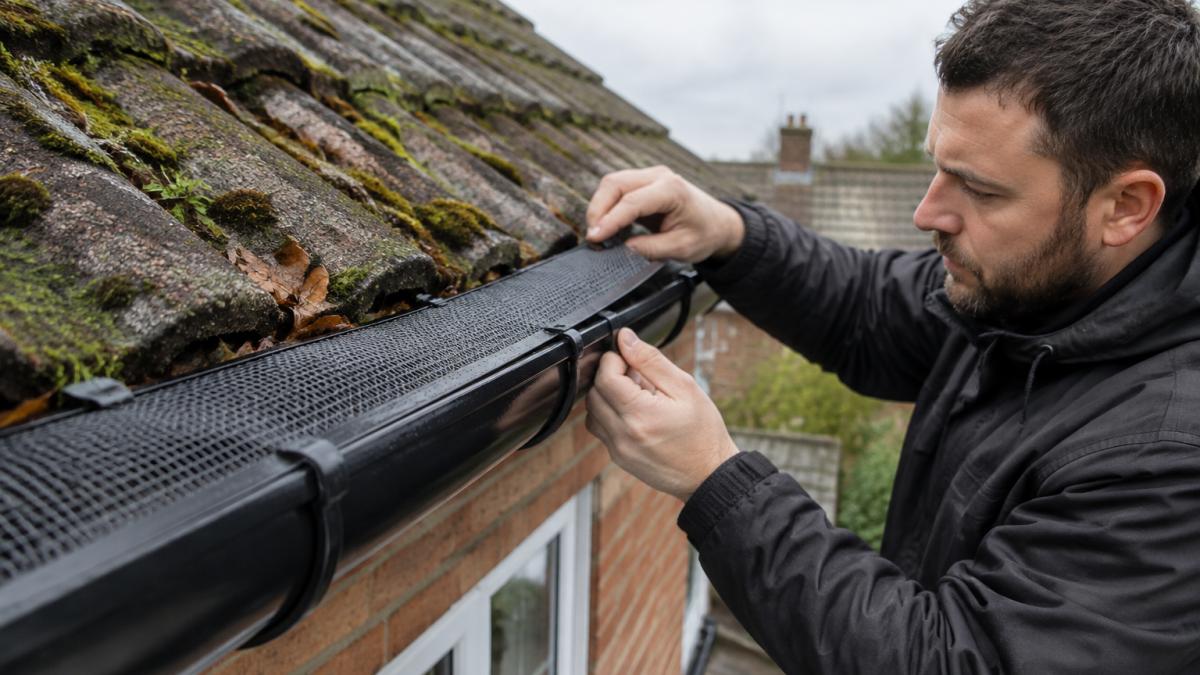
Most UK homes have either half-round or square-line uPVC gutters, in a small number of standard sizes. Guards are made to suit those profiles, and a guard designed for a different profile will not sit correctly however carefully you fit it. This is the part of the buying decision that generic national guides skip, and it is where a locally informed assessment earns its place.
Half-round versus square-line. Half-round gutters have a curved lip that many clip-on guards are designed to grip. Square-line gutters have a flatter lip and a squarer internal channel, and a guard made for a half-round profile may sit proud, leave gaps at the ends or fail to clip securely. The result is a guard that looks fitted but lifts in wind or lets debris in at the joints. Check the profile before you buy, not after.
Roof edge and tile overhang. Guards either sit under the bottom row of tiles or rest on the gutter lip. On roofs where the tiles overhang the gutter, a guard that sits on the lip may be pushed out of position by the tile edge. On roofs with a shallow overhang, a guard that relies on being tucked under the tiles may not have enough purchase. The roof edge detail matters as much as the gutter profile.
