
Table of Contents
- Why Cleaning Gutters Without Damaging Roof Tiles Matters
- Gutter Cleaning Safety Tips Before You Start
- Best Gutter Cleaning Tools for Homeowners
- Step-by-Step: Cleaning Gutters Without Damaging Roof Tiles
- Post-Cleaning Structural Integrity Check
- How Long Does It Take to Clean Gutters?
- When to Call a Professional Instead
- Conclusion
Last Updated: August 15, 2026
Why Cleaning Gutters Without Damaging Roof Tiles Matters
Blocked gutters are one of the most common causes of water ingress in residential properties. Water that cannot drain freely backs up behind the fascia board, saturating timber, lifting tiles, and driving moisture into the roof structure. Aggressive cleaning methods, standing on roof tiles, using pressure washers at close range, often create the very damage they were meant to prevent. This guide covers the right tools, correct sequence, and tile-specific considerations that determine whether a gutter clean protects your property or puts it at risk.
Gutter Cleaning Safety Tips Before You Start
Falls from ladders account for a significant proportion of serious DIY injuries each year. Before any equipment touches a gutter, conditions on the ground and at height must be assessed carefully.
Ladder Stability and Stand-Off Positioning
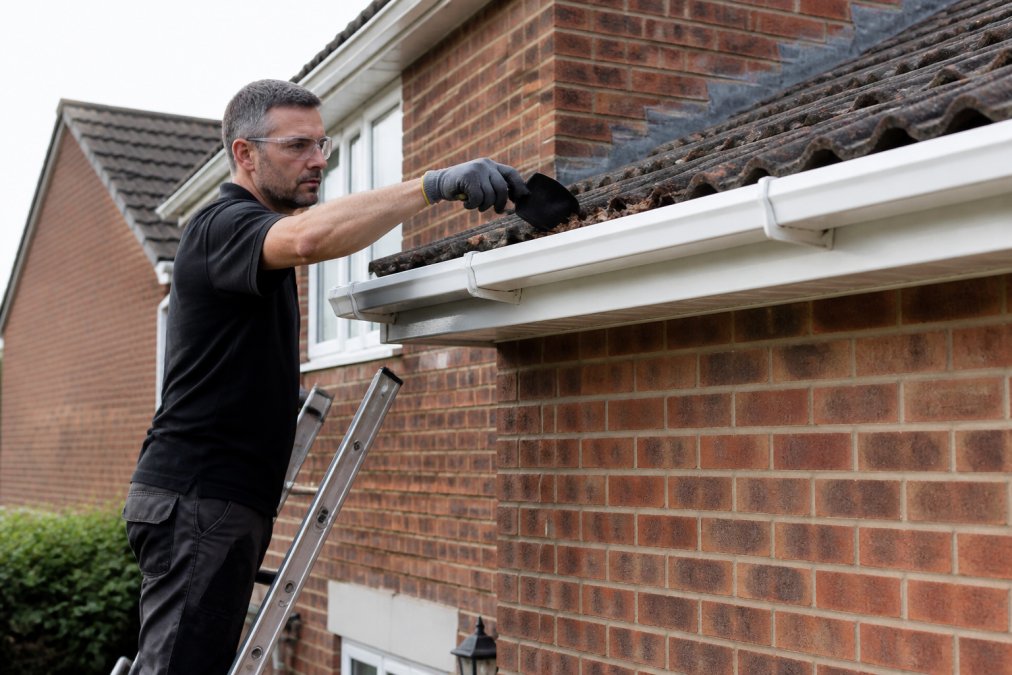
Never lean a ladder directly against the gutter itself. PVC gutters are not load-bearing; resting a ladder against them breaks seals at joints and pulls gutter hangers away from the fascia board. Use a ladder stand-off, which holds the ladder away from the wall and distributes contact onto the masonry rather than the gutter profile. Position the ladder at the correct angle: roughly one unit out for every four units of height. On uneven ground, use a ladder leveller rather than improvising with bricks or timber. Always ensure someone else is present to foot the ladder.
Never step onto roof tiles to extend your reach. Roof tile fragility varies significantly by material and age, and even tiles that appear sound can fracture under point loading.
Protective Gear and COSHH Awareness
Gutter debris contains decomposed organic matter, bird droppings, algae, and potentially biocide-treated moss from previous roof cleans. Wear nitrile or heavy-duty rubber gloves, safety glasses, and a dust mask rated at least FFP2 when clearing debris. If applying any cleaning product to the gutter channel, read the product label and safety data sheet in full before use. Under the Control of Substances Hazardous to Health Regulations, even domestic users have a responsibility to handle cleaning chemicals safely and in accordance with manufacturer instructions. Never mix cleaning products, and follow disposal guidance on the label.
Best Gutter Cleaning Tools for Homeowners
The right tool makes the difference between a clean that protects and one that damages.
| Tool | Best For | Key Consideration |
|---|---|---|
| Gutter scoop | Removing compacted debris | Use plastic, not metal, to protect PVC gutters |
| Telescopic vacuum with gutter attachment | Ground-level debris removal | Requires dry conditions to work effectively |
| Gutter claw | Dislodging stuck leaf matter | Gentle action; avoid forcing against tile edges |
| Ladder stand-off / stabiliser | Safe ladder positioning | Essential for any ladder work near gutters |
| Garden hose with gutter wand | Flushing debris toward downspout | Low pressure only; not a substitute for a pressure washer |
| Wet/dry vacuum with curved nozzle | Fine debris and silt removal | Useful for metal gutters where scooping is difficult |
Ground-Level Maintenance Options
Telescopic vacuum systems and extendable gutter wands allow debris removal from ground level without climbing. A telescopic vacuum uses a curved nozzle to reach into the gutter channel, pulling out dry debris without the operator leaving the ground. This works well for routine maintenance between full cleans, clearing light debris accumulation before it compacts. The limitation is that telescopic systems cannot dislodge compacted material effectively or inspect the gutter interior for cracks, failing seals, or sagging sections. Ground-level maintenance is best treated as a supplement to, not a replacement for, a proper seasonal clean.
Gutter Guard Compatibility Considerations
Gutter guards, mesh covers or foam inserts that sit inside or over the gutter channel, are increasingly common on properties where debris accumulation is recurring. Some gutter guards must be removed before the gutter can be properly cleared, while others can be cleaned in place with a low-pressure rinse. Foam insert guards tend to trap fine silt and moss spores within the foam itself over time. Check the manufacturer's guidance before cleaning. Forcing a gutter scoop or claw under a guard can deform the guard profile or damage the gutter hanger fixing points.
Step-by-Step: Cleaning Gutters Without Damaging Roof Tiles
Cleaning gutters correctly follows a clear sequence. Skipping steps, particularly the initial dry debris removal before flushing, is the most common cause of downspout blockages during the clean itself.
- Inspect the gutter run from ground level first. Look for obvious sagging, joint separation, or sections where the gutter slope appears incorrect.
- Position your ladder with a stand-off fitted. Never lean the ladder against the gutter. Start at the end furthest from the downspout.
- Remove dry debris with a plastic gutter scoop or gutter claw. Work in sections, depositing debris into a bucket hung from the ladder.
- Work toward the downspout, not away from it. This prevents debris from being pushed over already-cleared sections.
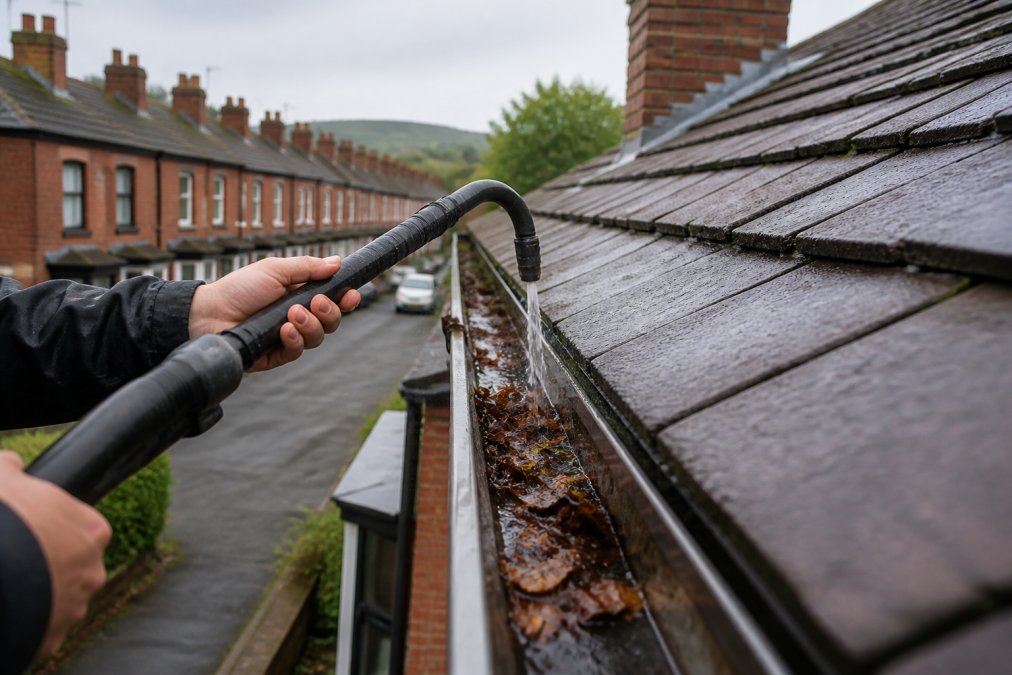
- Flush the gutter channel with a low-pressure hose or gutter wand. Use a steady flow to move remaining fine debris toward the downspout opening.
- Check the downspout for blockages. Feed the hose into the downspout from the top. If water backs up immediately, the blockage is near the top; if it backs up after a delay, the obstruction is lower in the pipe.
- Clear the downspout from the base if blocked. Use a drain rod or plumber's snake to dislodge the obstruction from below rather than forcing water down from above.
- Inspect gutter seals and joints after flushing. Joints that leak under low-pressure flow will need resealing before the next rainfall.
Debris Removal and Gutter Scoop Technique
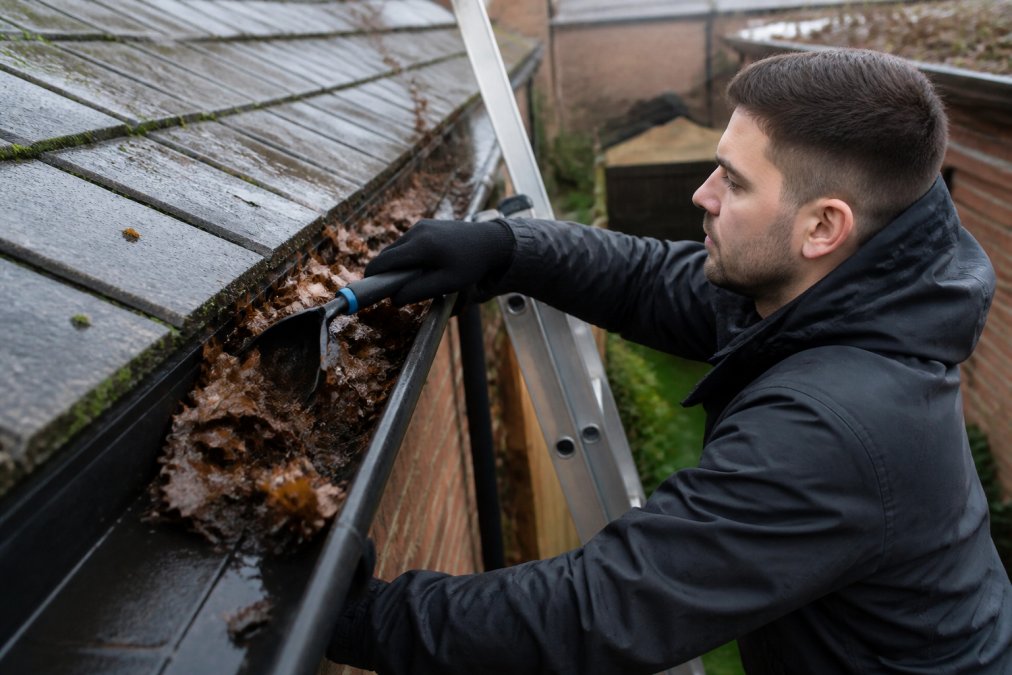
Always use a plastic scoop on PVC gutters, angling it so the leading edge follows the curve of the gutter profile rather than scraping across it. A metal scoop used with force will score the internal surface over time, creating rough patches where debris catches and builds up faster. For metal gutters, a metal scoop is acceptable, but work with the profile, not against it. Avoid using a gutter claw near tile edges, as the claw's reach can catch on the underside of a roof tile and lift it slightly, breaking the interlocking seal on concrete or clay tiles.
Flushing Downspouts and Checking Drainage
Flushing the downspout confirms the entire system is functioning. A gutter that drains but discharges water at the base of the wall rather than into a drain suggests a disconnected downspout joint. After flushing, check the ground-level outlet: water should discharge cleanly into the drain or soakaway, not pool around the base of the downspout. If clearing the gutter and downspout does not resolve slow drainage, the issue may require a drain survey.
Tile Material Considerations: Clay, Concrete, and Slate
Clay tiles are durable but brittle at the edges. Older clay tiles may have become friable over decades of weathering. Any contact with a ladder, tool, or hand near the tile edge risks chipping or cracking. Keep all tools within the gutter channel and avoid resting anything against the tile surface.
Concrete tiles are generally stronger than clay, but they are heavier. A dislodged concrete tile presents a serious hazard below. Concrete tiles are also more prone to moss and algae colonisation at the leading edge. Clear this growth carefully before reaching into the gutter to avoid unknowingly displacing a tile that has already lifted.
Slate is the most fragile of the three under point loading. Natural slate splits along its grain, and even a moderate impact can cause a tile to fracture. On properties with slate roofs, gutter cleaning should be approached with particular caution. Avoid any contact with the slate surface.