
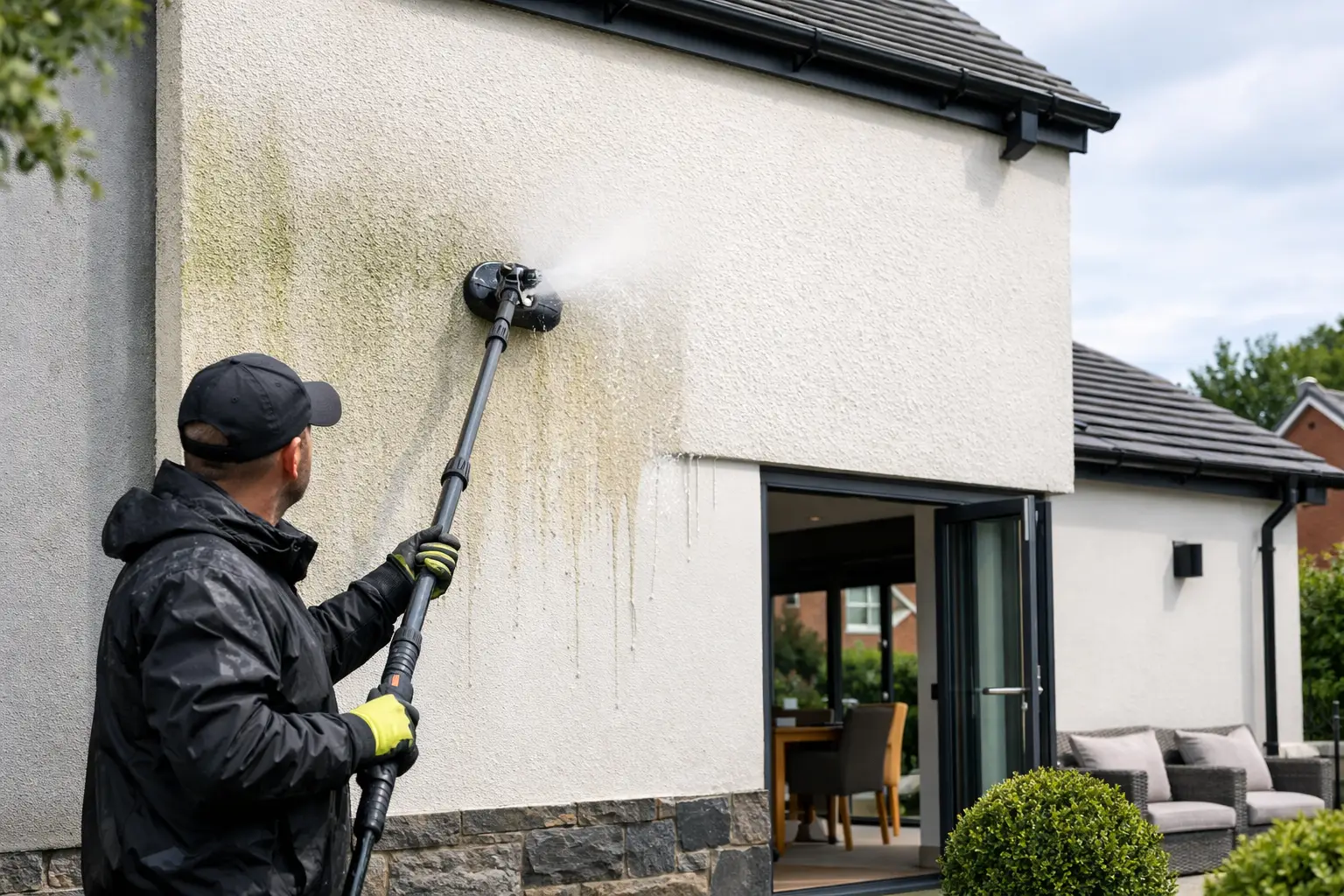
Render Cleaning in Cheshire: Why the Right Cleaning Method Matters
A green, blotchy rendered wall can make an otherwise well-maintained property look tired long before the render itself needs replacing.
Algae, lichen, atmospheric dirt and weather staining can gradually change a bright exterior into something that looks neglected.
Professional render cleaning in Cheshire can make a significant difference, but render should never simply be treated like a driveway or patio.
Using excessive pressure on the wrong type of render can potentially mark the finish, expose existing weaknesses or create more problems than it solves.
At Refresh Revive Exterior Cleaning, we assess the type of render, its condition and what's causing the discolouration before choosing a cleaning method.
For many rendered walls, that means using a carefully controlled low-pressure or soft-washing treatment rather than aggressive pressure washing.
Why does render turn green?
Render has a textured surface that can hold moisture and airborne contamination.
Walls that receive limited sunlight — particularly north-facing elevations — can remain damp for longer after rain.
Add nearby trees, vegetation, poor airflow or water running down the elevation and conditions can become ideal for organic growth.
Common problems include:
Green algae Lichen Black organic staining Red or pink staining Atmospheric dirt Traffic film Splashback around ground level Marks caused by leaking gutters or downpipes
The staining often develops so gradually that homeowners don't notice how much the appearance has changed until they compare it with a cleaner section of the property.
Not every green wall needs pressure washing
One of the biggest misconceptions about exterior cleaning is that stubborn staining simply needs more pressure.
Render is a good example of why that isn't true.
A rendered wall is very different from concrete paving.
Depending on the finish, aggressive pressure washing can potentially affect the surface itself.
That's why our starting point isn't:
“How powerful a pressure washer do we need?”
It's:
“What is this surface, what's causing the problem and what's the safest effective way of improving it?”
That difference matters.
Different types of render need different treatment
There isn't one cleaning process that should automatically be applied to every rendered property.
K Rend and silicone render
Modern silicone and coloured renders are popular because of their clean appearance, but they can still develop algae and atmospheric staining over time.
These surfaces normally benefit from a much more measured approach than traditional pressure washing.
Where appropriate, a low-pressure treatment can be used to tackle biological contamination without relying on aggressive mechanical force.
Read more about cleaning K Rend and silicone render.
Traditional cement render
Older cement-based render can be considerably more variable.
Some areas may be perfectly sound while others have hairline cracks, previous repairs, hollow sections or deteriorating paint.
That makes assessment particularly important.
Cleaning cannot repair existing failure within the render itself.
Painted render
Painted walls introduce another consideration.
The coating may already be chalking, peeling or fading.
Removing dirt can improve the appearance, but cleaning cannot restore paint that has deteriorated through age.
Sometimes cleaning actually reveals the true condition of the coating underneath.
What is soft washing?
Soft washing is a lower-pressure exterior-cleaning method that relies less on mechanical force and more on an appropriate treatment for the contamination present.
For organic growth such as algae, lichen and similar staining, this can often be better suited to render than aggressive pressure washing.
Find out more about our soft-washing service.
The important point is that soft washing isn't simply spraying chemicals onto a wall.
The treatment needs to be appropriate for the surface and contamination.
Application, dwell time, surrounding planting, windows, doors, drainage and neighbouring surfaces all need consideration.
Using less pressure doesn't mean doing less work. It means using a method that better suits the material.
Why test patches can be important
Where appropriate, we may carry out a small test in a discreet area before treating a larger elevation.
This helps us assess how the render and staining respond.
It's particularly useful when dealing with:
Older render Previous coatings Unknown paint finishes Unusual staining Historic repairs Delicate or weathered surfaces
Professional exterior cleaning isn't about assuming every wall will behave the same way.
It's about checking first.
When does controlled pressure have a role?
Low-pressure treatment is often suitable for biological contamination, but that doesn't mean pressure never has a place.
Some exterior walls may also carry general dirt, splashback, atmospheric grime or other contamination.
A controlled rinse or combination of methods may therefore form part of the cleaning process.
The important word is controlled.
Pressure, water flow, working distance and technique should all be adjusted according to the wall.
Owning powerful equipment isn't the same as knowing when to use that power.
Why gutters should be checked too
Sometimes dirty render is actually showing you another problem.
If a gutter is overflowing or a downpipe is leaking, water may repeatedly run down the same section of wall.
That can encourage organic growth and create obvious streaking.
Cleaning the render without addressing the water problem may therefore only provide a temporary improvement.
Where we see signs of this, we'd rather point it out.
Find out more about gutter, fascia and soffit cleaning.
The principle is simple:
Deal with the cause where possible, not just the visible symptom.
What do we check before cleaning render?
Before starting, we look at the general condition of the wall.
Things that may affect the cleaning approach include:
Cracks Loose or hollow render Flaking paint Previous repairs Open joints around windows Failed sealant Water staining Damaged roofline components Overhanging vegetation Access restrictions
If an area is already breaking down, applying water or treatment may not be sensible until the underlying issue has been considered.
Sometimes the professional answer is to tell a customer not to clean an area yet.
We'd rather do that than take a job that risks making existing damage worse.
Will render cleaning make the wall look brand new?
It can make a dramatic difference, but we don't promise every wall will return to a perfect, factory-new appearance.
Once algae and surface contamination have been removed, other conditions may become more noticeable.
These can include:
Faded paint Historic repairs Hairline cracks Permanent mineral staining Colour variation Weathering Differences in texture
Those aren't necessarily signs that the cleaning hasn't worked.
They may simply be the true condition of the wall becoming visible again.