
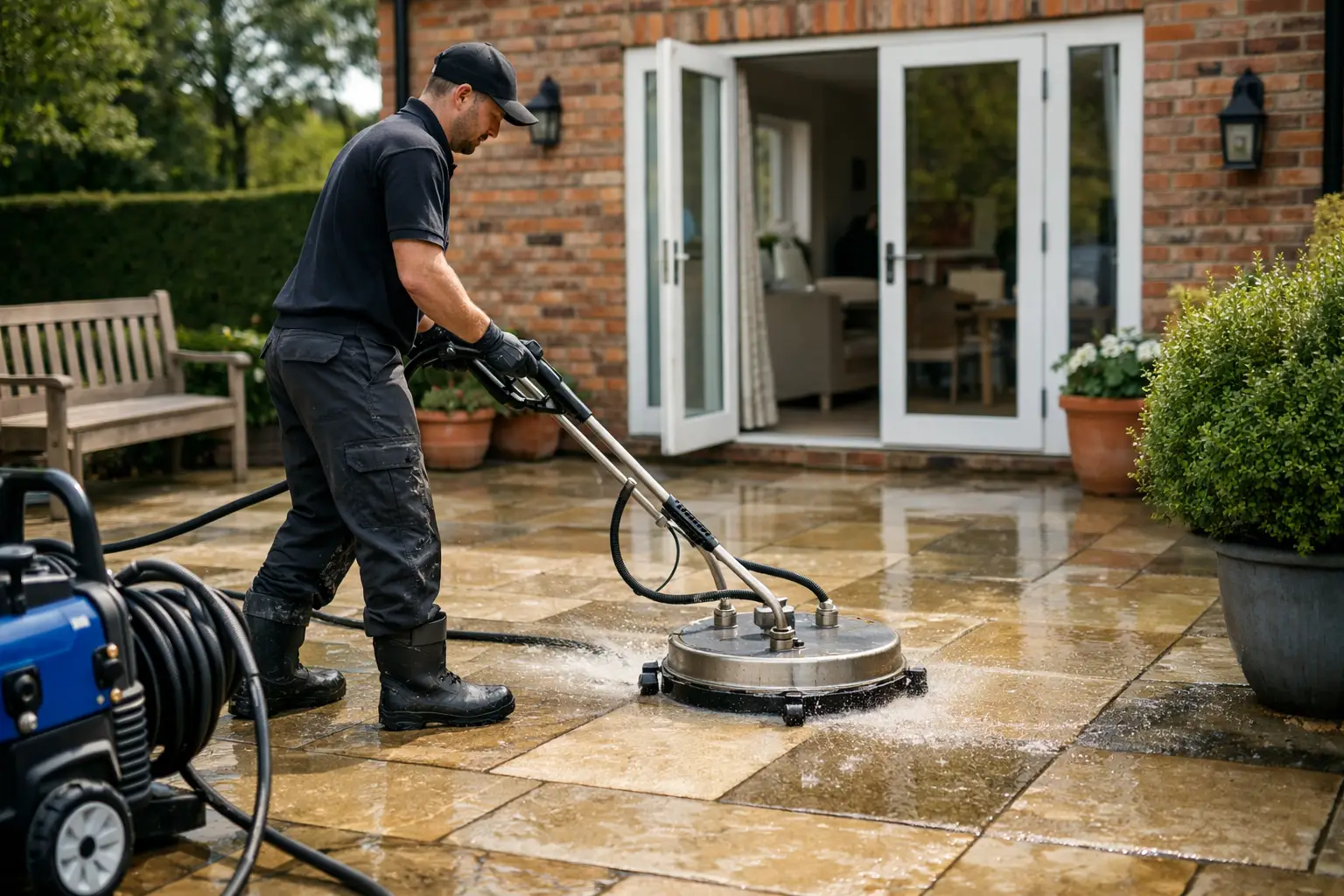
Patio Cleaning in Cheshire: The Right Way to Clean Different Paving Surfaces
A patio can start looking tired long before the paving itself needs replacing.
Green algae, moss in the joints, dark organic staining and stubborn black spots can gradually change the appearance of an otherwise perfectly usable outdoor space. During wet weather, some of that growth can also make paving slippery underfoot.
Professional patio cleaning in Cheshire shouldn't simply mean applying as much pressure as possible.
The right cleaning method depends on what the patio is made from, its age and condition, what's causing the staining and what result can realistically be achieved without unnecessarily risking damage to the paving.
At Refresh Revive Exterior Cleaning, we assess the surface first and then choose the cleaning method to suit it.
Whether we're dealing with block paving, concrete, porcelain, natural stone or Indian sandstone, the principle remains the same:
The surface determines the method — not the pressure washer.
Why do patios become green and dirty?
Outdoor paving has to deal with everything the British weather can throw at it.
Rain, shade, trees, nearby planting and limited airflow can all create conditions where algae, moss and lichen begin to establish.
Patios underneath trees may also collect:
Fallen leaves Pollen Bird droppings Tree sap Soil Organic debris General airborne dirt
Outdoor cooking and entertaining areas can develop grease and food-related staining too.
Over time, all of this can make the original colour and character of the paving increasingly difficult to see.
But not every mark is the same.
And that's important when deciding how the patio should be cleaned.
What's actually growing on your patio?
Homeowners often describe everything green as moss and everything dark as dirt.
In reality, several different types of contamination may be present at the same time.
Green algae
Algae commonly appears as a green film across paving, particularly in damp or shaded areas.
Apart from affecting the appearance, it can become slippery when wet.
Moss
Moss often develops between slabs, around patio edges and within joints where moisture and organic debris can collect.
Lichen
Lichen can appear as pale, grey or darker crust-like patches attached to the paving.
It can be considerably more stubborn than loose surface dirt.
Black spot
Black spotting can be one of the more frustrating problems on patios.
Rather than simply sitting loosely on top of the paving, established organic growth may become attached within the surface texture, particularly on porous natural stone and concrete.
That means simply pointing a pressure washer at it isn't always enough.
A professional clean may make a dramatic improvement without every historic mark necessarily disappearing completely.
We'd rather explain that before starting than promise somebody a brand-new patio when the surface itself has years of natural weathering.
Patio cleaning should start by identifying the paving
One cleaning method shouldn't be used on every patio.
Before deciding how to approach the job, we need to understand what we're actually cleaning.
Block paving
Block paving can collect significant amounts of dirt, moss and weeds both on the blocks and within the sand-filled joints.
Controlled pressure cleaning can often produce an excellent improvement.
However, cleaning also removes some of the jointing sand.
That matters because the sand between the blocks isn't simply decorative. It forms part of the paving system.
After cleaning and once the surface has dried sufficiently, kiln-dried sand may need to be swept back into the joints.
Re-sanding improves the finished appearance and helps restore the joints.
It isn't, however, a repair for paving that is already sinking, badly moving or suffering from an underlying installation problem.
Indian sandstone and natural stone
Indian sandstone is a beautiful paving material, but it needs to be treated with respect.
The natural variations in colour, texture and porosity are part of what makes sandstone attractive.
They're also why we don't automatically attack it with maximum pressure.
One DIY problem we regularly see is pressure-washer striping.
This happens when the fan from the pressure washer is held too close or moved unevenly across the paving.
Instead of an even clean, the patio can be left covered in visible light and dark lines.
So technically the paving may be cleaner, but visually it can actually look worse.
Where appropriate, professional equipment and overlapping cleaning passes can help produce much more even coverage.
Some stubborn organic staining may also benefit from an appropriate treatment rather than relying entirely on mechanical pressure.
Concrete patios
Concrete can be extremely durable, but that doesn't mean every concrete patio should automatically receive maximum pressure.
Older concrete can have worn areas, exposed aggregate, cracks or previous treatments that need considering first.
Algae, dirt and ingrained contamination can often be improved considerably with professional cleaning, but cleaning cannot repair deterioration already within the surface.
Porcelain patios
Porcelain is less porous than many natural stones and can be easier to maintain.
That doesn't mean it never becomes dirty.
Grout and joints can still collect moss and organic material, while surface dirt can build up around edges, seating areas, planters and drainage channels.
The aim when cleaning porcelain is to remove the contamination while avoiding unnecessary damage to joints, edges and surrounding features.
Pressure washing versus lower-pressure treatment
Pressure washing is an excellent cleaning tool when it's used properly.
But power alone isn't what produces a professional result.
Water flow, nozzle choice, working distance, pressure and operator technique all matter.
For stubborn organic growth or more delicate surfaces, a soft-washing or lower-pressure cleaning treatment may sometimes be more appropriate.
In practice, a patio may benefit from more than one method.
For example, we may use an appropriate treatment to help deal with established biological growth before carrying out controlled cleaning of the surface.
Edges, joints and stubborn areas can then receive further attention as necessary.
There isn't a fixed recipe.
We choose the process according to what's actually in front of us.
When can hot-water cleaning help?
Hot water can be particularly useful when dealing with certain greasy or stubborn deposits on suitable exterior surfaces.
However, it isn't something every patio automatically needs.
Read more about the benefits of hot-water pressure washing.
The important point is that specialist equipment should be used because the job requires it — not simply because it's available.
The best method is the one that deals effectively with the contamination while respecting the surface underneath.
Why test patches matter
Cleaning chemicals and treatments shouldn't simply be applied blindly across an entire patio.
Where appropriate, we can carry out a small test in a less noticeable area first.
This allows us to see how the paving reacts before treating the main surface.
It is particularly useful where we're dealing with:
Natural stone Previous coatings Unusual staining Older paving Unknown sealers Delicate or weathered surfaces
Professional cleaning is as much about knowing when to be cautious as knowing how to clean aggressively.
What should a thorough patio clean include?
A patio isn't just the large open section in the middle.
Some of the areas where poor cleaning becomes most obvious are around:
Edges Steps Door thresholds Corners Drainage channels Walls Raised beds Transitions into paths and driveways
Loose debris should be considered before washing begins so leaves, soil and moss aren't simply pushed into drainage points or spread around the rest of the garden.
We also consider nearby doors, walls, air bricks, flower beds and other features.
That's part of the difference between simply washing paving and professionally cleaning an outdoor area.
Can patio cleaning make old paving look new?
Sometimes the improvement can be dramatic.
But we don't promise every patio will look brand new.
Once years of dirt and organic contamination have been removed, the true condition of the paving becomes visible.
That might reveal:
Natural colour variation Previous repairs Faded sections Historic staining Old coatings Weathering Worn jointing Differences between shaded and exposed sections
These aren't necessarily cleaning faults.
They're often simply what the material looks like underneath the accumulated grime.
Our approach is to aim for the best realistic improvement rather than make exaggerated promises.
What about loose pointing and damaged joints?
Cleaning can expose problems that have previously been hidden by dirt and moss.
Natural-stone and flag patios may have mortar joints rather than sand-filled joints.
If that pointing is already loose, cracked or deteriorating, cleaning won't repair it.