

Last Updated: November 8, 2026
Quick Summary
COSHH compliance is the UK framework that keeps the risks from exterior cleaning chemicals under control, protecting people, plants, drains and property. Employers must assess the hazards, choose suitable controls and train staff, and a documented assessment shows the risks were considered before work began.
- COSHH stands for the Control of Substances Hazardous to Health Regulations.
- Concentrated detergents, biocides and degreasers used outdoors usually fall under COSHH.
- Plain water is not covered by COSHH, but hot water and pressure still need a risk assessment.
- The assessment should name the method, substances, exposed people and emergency arrangements.
- Check the safety data sheet sections on hazards, first aid, handling, PPE and disposal.
Table of Contents
- Why COSHH Compliance Matters for Exterior Cleaning
- What COSHH Covers and Which Exterior Cleaning Products Fall Under It
- Employer and Employee Responsibilities Under COSHH
- COSHH Risk Assessment for Cleaning Chemicals, Step by Step
- Reading COSHH Safety Data Sheets for Cleaning Products
- PPE for Exterior Cleaning Chemicals: What to Choose and Why
- Protecting Run-Off, Drains, Planting and Passers-By
- Commercial Exterior Cleaning RAMS and COSHH Paperwork
- Booking a Compliant Exterior Clean: Your Next Step
- Frequently Asked Questions
Why COSHH Compliance Matters for Exterior Cleaning
If you hire an exterior cleaning company in Bolton, the chemicals they use are part of the job, not an extra. Biocides, detergents and surface treatments can harm people, plants and drains if they are handled carelessly. COSHH compliance is the UK framework that keeps that risk under control.
COSHH stands for the Control of Substances Hazardous to Health Regulations. The Health and Safety Executive (HSE) explains that employers must assess and control exposure to hazardous substances in the workplace, and outdoor cleaning work is no exception. HSE guidance on COSHH and hazardous substances
At Refresh Revive Exterior Cleaning, COSHH is a practical part of how we plan our work. Choosing the right product, diluting it correctly and protecting the surrounding garden and drains are all part of that planning.
Compliance matters for three simple reasons:
- People: Operators, staff and passers-by can be exposed through skin contact, splashes or fine spray.
- Property: Strong chemicals can damage render, paintwork, planting and lawns if used without thought.
- Responsibility: A documented assessment shows you have thought about the risks before the work starts.
What COSHH Covers and Which Exterior Cleaning Products Fall Under It
COSHH covers substances that can cause ill health (Control of Substances Hazardous to Health (COSHH)). For exterior cleaning, that usually includes concentrated detergents, alkaline and acidic cleaners, biocides used against algae, moss and mould, and some degreasers and rust removers.
Many common products carry hazard warnings on their labels, such as irritant, harmful or corrosive. If a product is hazardous, COSHH applies to how it is stored, mixed, applied and disposed of.
Plain water does not fall under COSHH. Pure water systems and hot water cleaning still need a risk assessment, though, because heat and pressure create their own hazards for operators.
Employer and Employee Responsibilities Under COSHH
Employers carry the main legal duty. They must identify the hazards, assess the risks, decide on controls and make sure those controls are used. They must also give staff suitable information, instruction and training.
Employees have duties too. They should:
- Follow the controls and procedures set out in the assessment
- Use the protective equipment provided
- Report spills, damaged containers or symptoms of exposure
- Keep chemicals in their correct containers and never mix products unless told to
A small team can meet these duties with a short, clear assessment and a briefing before each new job type. The key is that the paperwork matches what actually happens on site.
COSHH Risk Assessment for Cleaning Chemicals, Step by Step
A COSHH risk assessment for cleaning chemicals does not need to be complicated, but it does need to be specific to the job, the surface and the method. A generic assessment copied from a template will not stand up to scrutiny on a site where a biocide is being sprayed near a boundary, a drain or a public footpath. Here is a practical sequence that works for exterior cleaning work in Bolton and across Greater Manchester, Lancashire and Cheshire.
- List the substances. Name each product, including the biocide or detergent and its concentration. Record the supplier and the date of the safety data sheet (SDS) you are working from.
- Check the hazards. Read the label and the SDS for hazard statements, signal words and any exposure limits. Note whether the product is a concentrate or ready-to-use.
- Identify who is exposed. Think about operators, helpers, residents, pets, neighbours, passing pedestrians and nearby planting. On commercial sites, add staff, visitors and contractors working nearby.
- Consider how exposure happens. Look at skin contact, eye splashes, inhalation of spray or vapour, ingestion through poor hygiene, and spills. For exterior work, spray drift and run-off are usually the dominant routes.
- Decide on controls. Choose the least hazardous product that works, dilute correctly, select the application method that limits drift, and set up the work area to keep people and plants out of the zone.
- Plan for emergencies. Know where eyewash, first aid and spill kits are kept, and who is trained to use them.
- Record and review. Write it down, share it with the team, and update it when products, methods or sites change.
A common mistake is writing one generic assessment and never revisiting it. A new biocide, a change of nozzle, a site next to a school or a spell of windy weather can change the picture completely.
Matching Controls to the Method
The same chemical can carry very different risks depending on how it is applied. A COSHH assessment for exterior cleaning should say which method is being used and why.
- Pressure washing. High-pressure jets create fine aerosols and can bounce spray back at the operator. Controls usually include reducing pressure where the surface allows, using the correct nozzle, keeping the lance angle low, and screening the work zone. Pressure washing alone does not remove biological growth from render or delicate surfaces; it can drive water into the substrate and damage pointing, so it is generally better suited to hard paving and stone than used as a default. Our guide to black staining on rendered walls explains how low-pressure cleaning treats this safely.
- Soft washing. Low-pressure application of a diluted biocide or detergent relies on dwell time and chemical action rather than force. Controls focus on correct dilution, controlled application, protection of planting and drains, and keeping bystanders clear of drift. Soft washing is generally the more suitable method for render, painted surfaces, roofs and delicate substrates, where high pressure risks damage. You can read about our low-pressure soft washing in Bolton for these surfaces.
- Treatment-led cleaning. Some jobs are about applying a treatment and letting it work, then rinsing or returning later. Controls include recording application rates, monitoring weather, and planning return visits so the treatment is not over-applied.
- Hot water cleaning. Heat can improve cleaning performance and reduce the need for aggressive chemicals, but it adds burn risk and can increase vapour. Controls include guarded equipment, correct PPE and managing the work area.
Worked Example: A Driveway and Render Job Near a Care Home
Imagine a block-paved driveway at a house beside a care home in Bolton, with painted render on the front wall. The team plans to use a low-pressure soft wash with a diluted biocide on the render and a detergent on the driveway.
- Substances: A diluted biocide for algae on render, and a detergent for the driveway. Both SDS documents are on file and current.
- Who is exposed: Operators, residents and staff at the care home next door, plus any plants along the boundary and pedestrians on the pavement.
- Controls: Use the lowest effective dilution, mask and protect the planting, apply at low pressure to limit spray drift, and keep the care home's windows, gate and path clear of overspray. Set up cones and signs to keep the public out of the work zone.
- Run-off: Pre-wet surfaces where appropriate, control rinse water, and check the drain route before starting. Avoid discharging concentrated chemical into surface-water drains.
- Weather: Check wind direction and strength before starting, and pause if drift cannot be controlled.
- Emergency plan: Keep eyewash and a spill kit on the van and know the nearest first aid point.
- Review triggers: A change of biocide, a change of nozzle, a new neighbour complaint, or a forecast of high wind should all prompt a review before work continues.
Watch out: a risk assessment that lists controls but does not say who checks them on the day tends to fail in practice. Name the supervisor responsible for the pre-start check.
This kind of job-specific thinking is what makes a COSHH assessment useful rather than a box-ticking exercise, and it is the level of detail commercial clients and facilities managers should expect from any contractor's RAMS pack.
Reading COSHH Safety Data Sheets for Cleaning Products
The safety data sheet is the most useful document you will get for any chemical. It tells you the hazards, the first aid steps, the protective equipment to use and how to handle spills.
When you read an SDS for an exterior cleaning product, focus on these sections:
- Section 2: Hazard identification. Look for hazard statements and signal words such as Danger or Warning.
- Section 4: First aid measures. Know what to do after skin or eye contact.
- Section 7: Handling and storage. Check dilution limits and storage conditions.
- Section 8: Exposure controls and PPE. This tells you what protection the product requires.
- Section 13: Disposal considerations. Important for where rinse water and leftovers can go.
Keep a folder of current SDS documents on the van or in the office. Check them again whenever the supplier changes the formula.
The safety data sheet is the most useful document you will get for any chemical, so these are the sections to focus on:
| SDS section | What it tells you | Why it matters |
|---|---|---|
| Section 2: Hazard identification | Hazard statements and signal words such as Danger or Warning | Shows the level of risk before you open the container |
| Section 4: First aid measures | What to do after skin or eye contact | Lets you act quickly if exposure happens |
| Section 7: Handling and storage | Dilution limits and storage conditions | Keeps mixing and storage within safe limits |
| Section 8: Exposure controls and PPE | The protective equipment the product requires | Tells you what to wear for the task |
| Section 13: Disposal considerations | Where rinse water and leftovers can go | Prevents chemicals entering drains or planting |
PPE for Exterior Cleaning Chemicals: What to Choose and Why
Personal protective equipment is the last line of defence, not the first. It works best alongside good product choice, correct dilution and sensible application methods. The SDS will usually specify the minimum PPE, but the assessment should decide what is actually needed for the task, the method and the site.
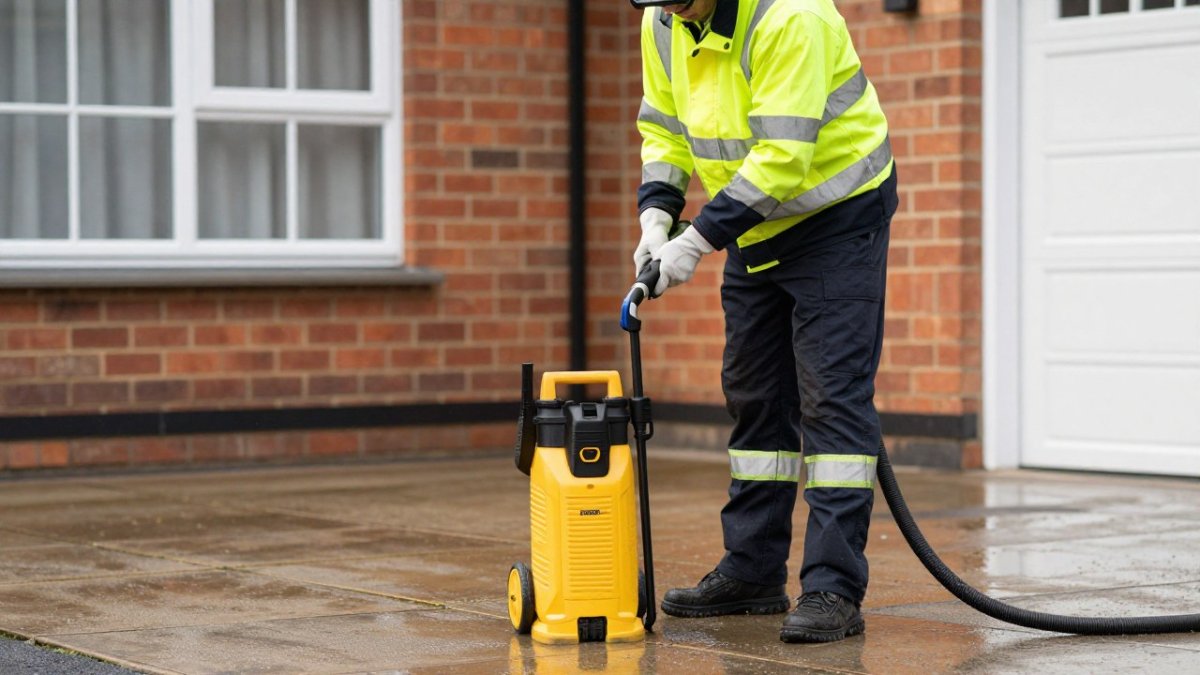
For most exterior cleaning chemicals, a sensible starting kit includes:
- Chemical-resistant gloves suited to the specific product
- Safety goggles or a face shield when splashing is possible
- Waterproof clothing with long sleeves
- Safety footwear with good grip for wet surfaces
- Respiratory protection where fine spray, vapour or powder is a concern
