
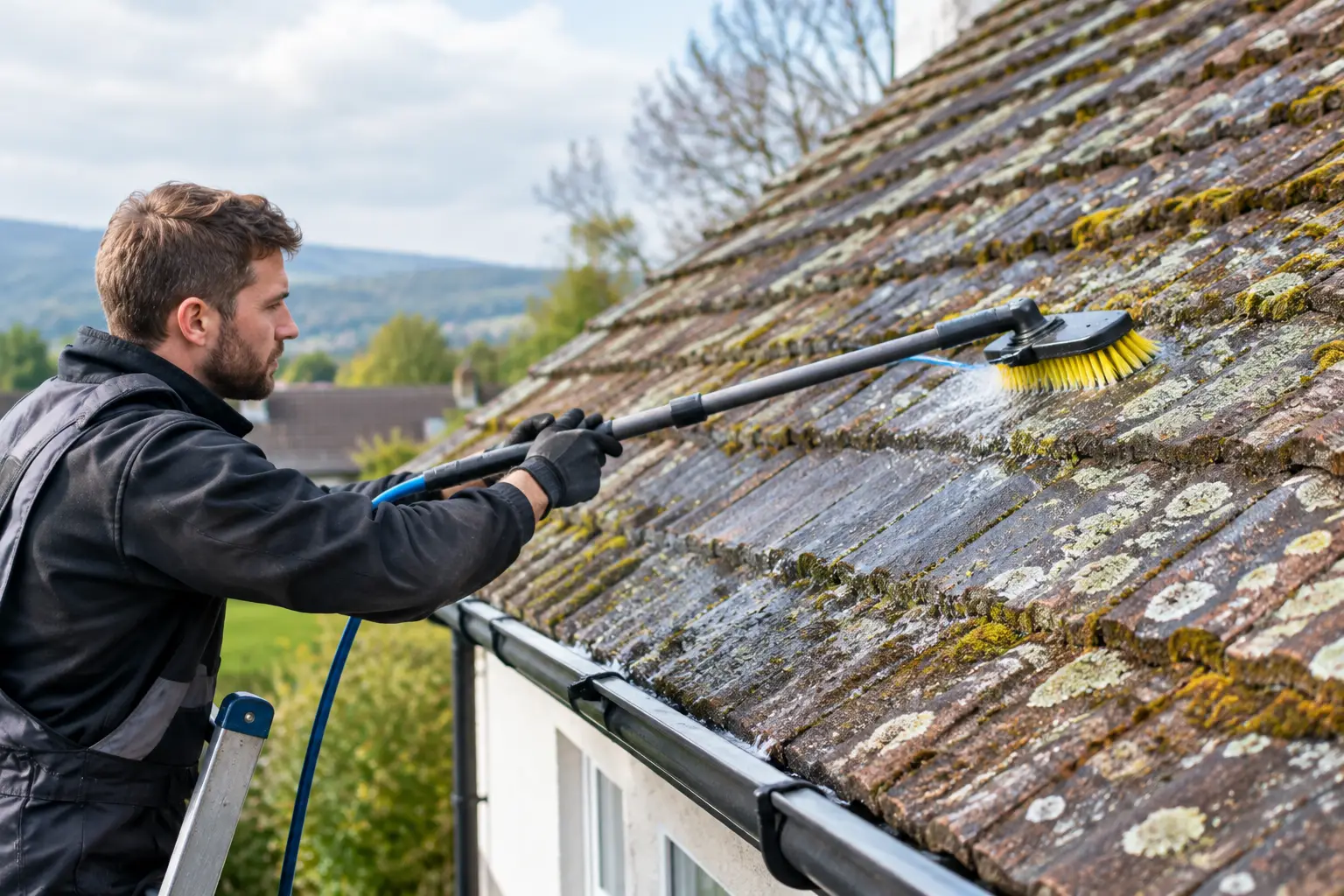
A pale, crusty patch on a roof is rarely just a cosmetic issue. Lichen grips tightly to tile surfaces, holds moisture and can make an otherwise well-kept property look neglected. Knowing how to remove roof lichen starts with recognising that the safest method is usually treatment rather than force. High-pressure cleaning, scraping or harsh household chemicals can create more problems than they solve, particularly on older, weathered or delicate tiles.
For most homes, the sensible approach is to assess the roof material, the amount of lichen present and the condition of the tiles before selecting a low-pressure cleaning or treatment method. The aim is to deal with the growth without disturbing the roof covering, mortar, flashings or gutters.
What roof lichen is and why it is difficult to remove
Lichen is not the same as moss. Moss is soft, green and often forms thicker clumps, especially in shaded sections of a roof. Lichen is a combined growth of fungi and algae that forms flat or raised patches in shades of grey, green, white, yellow or orange. It attaches itself firmly to the surface beneath it.
On concrete tiles, lichen can settle into the textured finish and become increasingly stubborn over time. On clay tiles, slate and fibre-cement coverings, the cleaning approach needs even more care because the surface may be more vulnerable to abrasion, cracking or loss of its protective finish.
Its presence does not automatically mean a roof is failing. However, widespread growth can retain dampness, obscure the condition of tiles and collect around overlaps and roof details. When moss, leaf debris and lichen occur together, they can also contribute to blocked gutters and downpipes.
How to remove roof lichen safely
The right answer depends on the roof. A newer concrete-tile roof with localised lichen may respond well to a carefully applied roof treatment. A roof with loose, cracked or heavily weathered tiles may need a more cautious approach, or repairs before cleaning is considered.
In many cases, roof lichen is treated with a suitable low-pressure application. The treatment works into the growth and helps it break down over time, with rainfall gradually carrying away the residue. This is less dramatic than blasting a roof clean in one visit, but it avoids relying on force where force may be unsuitable.
Some loose moss and debris can be removed by hand using appropriate access equipment and controlled tools. Lichen should not simply be chipped, wire-brushed or aggressively scraped from tiles. Those methods can mark the surface, dislodge granules from some concrete tiles, crack brittle materials or disturb the laps that keep water moving off the roof.
A professional roof cleaner should consider the roof pitch, tile type, age, access, nearby conservatories and landscaping, as well as the state of gutters. Run-off and debris need to be managed properly, not left to accumulate at ground level or inside rainwater goods.
Why high-pressure roof washing is usually the wrong starting point
Commercial pressure-washing equipment has a place in exterior cleaning, but it is not a one-method solution for every surface. A driveway or durable patio may tolerate controlled pressure very differently from a tiled roof.
High-pressure water on a roof can strip surface coatings, force water beneath tiles, disturb pointing and send debris into gutters. It can also leave a roof looking clean initially while failing to address the spores and residue that encourage regrowth. There are situations where carefully controlled cleaning may form part of the work, but it should follow an assessment of the specific roof rather than an assumption that more pressure equals a better result.
The same caution applies to hiring a pressure washer for a weekend attempt. Working at height is hazardous, and an uneven roof surface becomes more dangerous when wet. A ladder does not make a roof safe to walk on, particularly where tiles are damp, brittle or coated in biological growth.
Avoid household shortcuts and harsh scraping
It can be tempting to use bleach, washing-up liquid, vinegar or a strong off-the-shelf cleaner. Roofs drain into gutters, downpipes, garden areas and sometimes water butts, so the consequences need consideration. Household products may be ineffective on established lichen, leave staining, affect nearby surfaces or vegetation, or be unsuitable for the roof material.
Avoid using a metal scraper, stiff wire brush or abrasive pad. Even where the lichen appears to lift away, the tool may scratch the tile finish or cause unnecessary wear. A roof is not a patio. It has overlaps, fixings, valleys, flashings and vulnerable edges that need a method designed for the surface.
If a small patch is visible from ground level, take photographs rather than climbing up for a closer look. Clear images of the roof slope, the affected area, gutters and any visible damaged tiles give a cleaning specialist a better starting point for advice.
Check the roof and gutters before treatment
Lichen often appears alongside other roof-maintenance issues. Before treatment, look from the ground for slipped or broken tiles, cracked ridge mortar, blocked gutters, overflowing downpipes and vegetation touching the roof. These do not always prevent cleaning, but they may change the order of work.
Gutter clearance is particularly relevant where moss and lichen fragments are present. If the gutters are already full of debris, cleaning the roof without addressing them can create a blockage at the next period of heavy rain. On properties with conservatories, extensions or flat-roof sections below, careful planning is needed to avoid deposits collecting in valleys and outlets.