28 August 2026 · Last updated 30 August 2026 · Refresh Revive Exterior Cleaning — 10 years of industry experience and £5 million insurance cover.
Compare professional exterior cleaning alternatives for homes. Find fully insured services for driveways, roofs, and gutters across the North West. Get a.
Why Homeowners Choose Professional Exterior Cleaning Alternatives
Homeowners across the North West face a persistent problem: moss, algae, and grime accumulate on roofs, driveways, and patios faster than DIY methods can handle. What starts as surface discolouration becomes a structural concern. The question isn't whether to clean, it's how to do it safely without damaging the surfaces you're trying to restore.
High-pressure washing can strip protective coatings, erode mortar, and damage delicate surfaces (peer-reviewed research). Low-pressure alternatives preserve your property whilst removing years of buildup. Understanding the difference between these approaches determines whether your home looks restored or compromised.
At Refresh Revive Exterior Cleaning, we've seen the aftermath of aggressive pressure washing: pitted stone, gouged render, granules stripped from roof shingles. We've also seen what happens when the right method meets the right surface: brilliant restoration without collateral damage.
Homeowners choosing professional exterior cleaning alternatives typically fall into three camps. First, those who've had bad experiences with pressure washing and want a safer approach. Second, those protecting new landscaping or delicate plants and needing assurance their investment won't be destroyed. Third, those managing commercial properties where appearance directly impacts business perception.
Damaged render requires expensive repairs. Stripped roof granules mean accelerated deterioration. Compacted soil around newly planted shrubs kills establishment. A temporary saving on a cheap clean becomes a permanent expense in repairs.
Key TakeawayThe difference between a good exterior clean and a damaging one comes down to method selection, not just price. Low-pressure, surface-specific approaches cost more upfront but protect your property's long-term value and appearance.
Low-Pressure Roof Cleaning Benefits and Surface Protection
Roof cleaning sits at the intersection of aesthetics and structural integrity. Moss and algae trap moisture, accelerate weathering, and create conditions for tile or shingle failure (peer-reviewed research). Yet high-pressure washing introduces its own risks.
Low-pressure roof cleaning applies appropriate pressure calibrated to your specific roof material. For asphalt shingles, this protects the granule coating that gives weather resistance and lifespan. For slate or clay tiles, it avoids micro-fractures that high pressure creates. For render and stone, it preserves the surface without blasting away mortar joints.
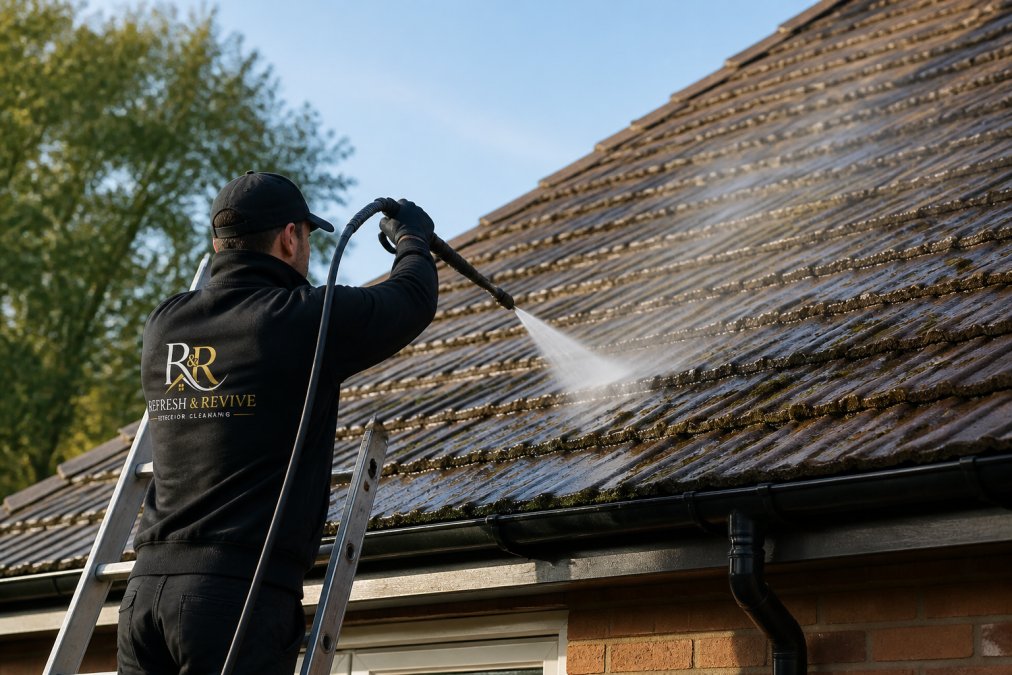
Professional demonstrating soft washing technique on residential roof with moss-covered shingles, water spray at low pressure, morning light illuminating the treatment area
Assessment begins the process. Different roof materials require different approaches. A competent service identifies your roof type, checks for existing damage, and selects cleaning solutions and pressures accordingly. This is surface-specific methodology, not guesswork.
Biocide treatments often form part of professional roof cleaning, inhibiting regrowth of moss and algae and extending intervals between cleans. Quality services apply treatments according to product specifications and relevant safety protocols, following product labels and safety data sheets rather than improvising with household solutions.
Proper low-pressure cleaning allows sufficient contact time for treatment to break down biological growth, then rinses thoroughly. The algae is dissolved, not just pushed around. Protection of surrounding areas matters too: gutters, downpipes, plants, and soil all sit beneath a roof during cleaning. Professional services manage runoff through careful water direction and choice of treatments that minimise environmental impact.
Pro TipIf a service quotes roof cleaning without asking about your roof material, material condition, or surrounding landscaping, they're not performing surface-specific assessment. This is a red flag for a one-size-fits-all approach that may damage your property.
Driveway and Patio Restoration Services
Driveways and patios accumulate grime differently than roofs. Heavy foot traffic, vehicle weight, weather exposure, and organic growth create a grimy, slippery surface. Restoration here isn't just aesthetic; slippery surfaces create genuine safety hazards.
Concrete, asphalt, block paving, and natural stone all respond differently to cleaning. Concrete can handle more aggressive treatment than sandstone. Asphalt requires gentler pressure to avoid displacement. Block paving needs careful technique to avoid dislodging individual blocks. Natural stone demands respect for its porosity and composition.
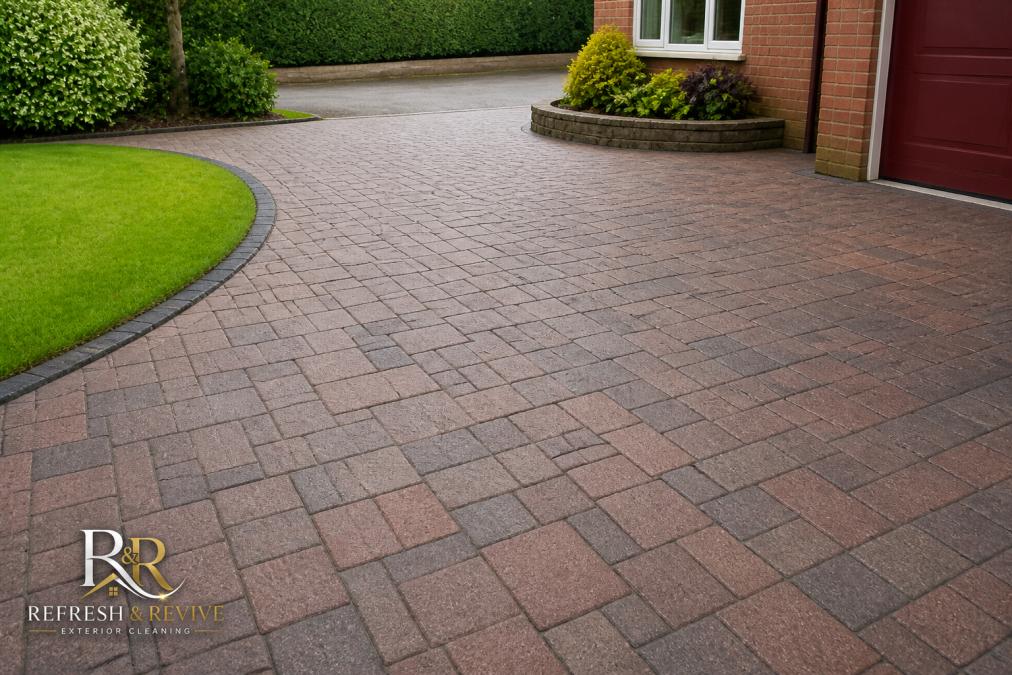
Restored driveway and patio area after professional cleaning, showing renewed colour and texture detail, with lawn and planted borders visible at the edges, natural daylight
Professional services employ a tiered approach. Initial assessment determines material type and condition. Appropriate pressure and cleaning solutions are selected accordingly. For heavily soiled surfaces, pre-treatment allows cleaning solution to penetrate and break down ingrained dirt before pressure application.
Excellence shows in the details: edge work, debris removal from joints, careful handling of adjacent planted areas, thorough rinsing to remove all cleaning residue, and surface sealing afterward to provide ongoing protection.
Cleaning often reveals underlying problems. Efflorescence (salt deposits) on new concrete. Algae growth indicating poor drainage. Cracks suggesting structural movement. A thorough service identifies these issues and advises on remediation, rather than simply cleaning the surface.
Regrowth prevention differs from roof cleaning. The focus shifts toward surface sealing and maintenance schedules. Quality services discuss how to extend the clean, what cleaning frequency prevents regrowth, what conditions accelerate it, and whether protective sealants suit your surface type.
Hiring Insured Exterior Cleaners: What Matters Most
Insurance represents a critical distinction between professional services and casual operators. When a cleaning service is fully insured, you have recourse if something goes wrong. Damage to your property, injury to personnel, or environmental contamination, insurance covers investigation and compensation. Without it, you're pursuing the individual or company directly, which often proves fruitless.
Request proof of public liability insurance covering the specific services they provide. Check the coverage amount reflects your property's value and potential for damage. Verify the policy is current. Ask whether they hold employers' liability insurance if they employ staff, and professional indemnity if they provide advice about your property's condition.
Beyond insurance, competence indicators matter. Has the service worked with your specific surface type? Can they provide references from similar properties? Do they offer before-and-after documentation? Do they explain their method and why it suits your surfaces?
A confident, professional service has a clear answer to: "What's your contingency if something goes wrong?" They've encountered issues before and know how to address them. They stand behind their work with a transparent process, not vague reassurances.
Consider what you're comparing when evaluating cost. A service quoting significantly below others may be cutting corners on equipment, training, insurance, or time. The lowest price often reflects the lowest standard, not superior efficiency.
Watch OutNever hire a cleaner who advises mixing cleaning chemicals, using vinegar or bicarbonate of soda as post-treatment neutralisers, or improvising chemical solutions. These practices violate safety protocols, damage surfaces, and create health hazards. Legitimate services follow product labels, safety data sheets, and COSHH controls.
Exterior Property Maintenance Checklist for Long-Term Results
Roof condition: Inspect annually, particularly after storms. Look for loose or damaged tiles, excessive moss or algae growth, blocked gutters, or deteriorating flashing.
Gutters and downpipes: Clear debris seasonally (spring and autumn). Check for sagging, leaks, or blockages that prevent proper water drainage.
Driveway and patio surfaces: Assess after winter for new cracks, subsidence, or drainage issues. Schedule cleaning before heavy organic growth establishes.
Render and brickwork: Monitor for cracks, efflorescence, or biological growth. Small cracks caught early prevent water ingress.
Window frames and sills: Inspect for rot, paint failure, or debris accumulation.
Landscaping around property: Ensure plants aren't growing directly against walls or render. Maintain clearance from gutters.
A practical maintenance schedule:
Task
Frequency
Purpose
Gutter clearing
Twice yearly (spring, autumn)
Prevent blockages and water damage
Roof inspection
Annually after winter
Identify damage early
Driveway/patio assessment
Seasonally
Catch cracks and drainage issues
Render and brickwork check
Annually
Monitor for structural concerns
Professional cleaning
Every 2-3 years (driveways, patios); every 3-5 years (roofs)
Prevent permanent staining and growth
The interval between professional cleans depends on local conditions. Properties in areas with high rainfall, shade, or organic growth need more frequent attention. Sunny, well-drained properties can extend intervals. A good service provider will advise based on your specific situation and location.
Maintenance visits address new growth and minor soiling before it establishes, keeping your property looking fresh with less intensive intervention. Refresh Revive Exterior Cleaning offers maintenance visits designed for this, preventing regrowth and keeping surfaces restored between major cleans.
Gutter Clearing and Roof Moss Removal
Blocked gutters prevent water drainage, causing overflow that damages fascias, soffits, walls, and foundations. Leaves, moss, and debris accumulate quickly, especially near trees.
Professional services clear debris, flush systems to verify flow, and identify damage, broken sections, sagging, or corrosion. Some services apply treatments to inhibit moss growth in gutters, extending the interval until next clearing.
Roof moss removal often accompanies gutter work. Moss growth indicates moisture retention, which accelerates deterioration. Professional moss removal addresses the growth itself and applies treatments to prevent rapid regrowth.
Several factors influence moss growth rate. North-facing roofs in shade grow moss faster. Areas with high rainfall and humidity create ideal conditions. Nearby trees dropping organic matter feed moss growth. Gutters that retain moisture provide a perfect environment. Understanding these factors helps predict maintenance intervals and plan accordingly.
Early intervention, removing moss before it establishes permanently, breaks the deterioration cycle and protects your roof's lifespan.
Professional Methods That Protect Your Property
The distinction between professional and amateur cleaning comes down to method. Professionals assess before they clean, select appropriate techniques, protect surrounding areas, and document results.
Assessment begins with questions. What's your surface material? What's its age and condition? Are there existing cracks, damage, or weak points? What's the source of soiling? What surrounds the area? This information determines everything that follows.
Equipment selection follows assessment. A professional service carries multiple pressure settings, various nozzle types, and diverse cleaning solutions appropriate to different surfaces and soiling types. They calibrate to the specific situation rather than applying the same approach to everything.
Protection of surrounding areas requires planning. Professional services manage runoff through careful water direction, temporary barriers where needed, and choice of treatments that minimise environmental impact.
Documentation provides accountability. Before-and-after photographs record the transformation, prove the work was done, establish a baseline for future maintenance, and provide evidence should disputes arise.
Refresh Revive Exterior Cleaning's approach embodies this professional methodology. Surface-specific methods tailored to your property's materials. Protective measures for surrounding landscaping and structures. Before-and-after documentation. One-working-day turnaround on quotations. Maintenance visits available to prevent regrowth.
One question homeowners should ask: "What makes your method different from pressure washing?" The answer reveals whether a service understands surface protection. Proper answers explain surface-specific assessment, material-appropriate technique selection, protective measures for surrounding areas, and follow-up maintenance options.
Choosing an exterior cleaning service means selecting a partner in property maintenance, not just purchasing a one-off clean. The right service understands that your home or business is an investment requiring protection, not a project for aggressive restoration that creates new problems.
Refresh Revive Exterior Cleaning delivers exactly this approach across the North West. Surface-specific, low-pressure methods that restore brilliance whilst protecting your property, planting, and landscaping. Fully insured, responsive, and committed to quality with before-and-after documentation and maintenance options available. Request a free, no-obligation quotation today; we typically respond within one working day.
Frequently Asked Questions
Why should I hire an insured exterior cleaning company instead of doing it myself?
Professional exterior cleaners carry liability insurance that protects your property if damage occurs during cleaning. They use surface-specific methods tailored to your driveway, roof, or render, rather than one-size-fits-all pressure washing that can strip protective coatings or cause lasting damage. Fully insured companies also have the expertise to avoid harming plants, lawns, and delicate surfaces, risks that DIY cleaning often creates. Insurance gives you recourse if something goes wrong; self-cleaning leaves you responsible for any damage.
What are the key benefits of low-pressure roof cleaning?
Low-pressure roof cleaning removes moss, algae, and grime without stripping protective granules from roof shingles or tiles. High-pressure methods can shorten roof lifespan by damaging the surface layer; low-pressure cleaning preserves structural integrity while restoring appearance. It's particularly effective for older roofs or properties with delicate finishes. Low-pressure methods also reduce water penetration risk and are safer for gutters and surrounding fixtures, making them the preferred choice for long-term roof protection.
How often should I have my driveway and patio professionally cleaned?
Most driveways benefit from professional cleaning every 12-18 months, depending on local climate and exposure to moss and algae growth. Patios in shaded areas may need more frequent attention. Regular cleaning prevents algae and moss from establishing deep root systems, making each clean more effective and longer-lasting. Many homeowners find that annual maintenance visits after an initial deep clean keep surfaces looking restored and reduce the need for heavy-duty restoration work later.
What should I look for when hiring an exterior cleaning company?
Check that the company is fully insured and can provide proof of coverage. Ask about their cleaning methods, surface-specific approaches (soft wash for render, low-pressure for roofs) indicate professionalism. Request before-and-after documentation to see their work quality. Confirm they offer free, no-obligation quotes and ask about response times and maintenance options. Look for companies that prioritise protection of your plants and lawns during cleaning, and ask how they handle drainage and prevent water damage to your property.
Discover how low pressure roof cleaning protects tile integrity, removes moss and algae safely, and extends your roof's lifespan. Learn the benefits today.
Professional block paving cleaning and re-sanding across Bolton, Greater Manchester, Cheshire and Lancashire. Remove moss, algae, weeds and grime and restore tired block-paved driveways.