
Last Updated: November 1, 2026
Quick Summary
Driveway soft washing is a low-pressure cleaning method that uses a specialist solution to kill and loosen algae, moss, lichen and grime, then rinses it away with water. Rather than relying on force, it works through chemistry and dwell time, which suits block paving, sandstone and porcelain drives.
- Soft washing relies on chemistry and dwell time rather than high pressure.
- Dwell time matters more than pressure, so rushing this stage leaves growth behind.
- The process runs in three stages: assess the surface, apply solution and allow dwell time, then rinse away.
- Soft washing suits block paving and sandstone, where a strong jet can damage joints.
- Some heavy stains and hard concrete still need controlled pressure, so the right method depends on the surface.
Table of Contents
- What Driveway Soft Washing Actually Is
- Soft Washing vs Pressure Washing a Driveway
- The Equipment and Solutions Used in Soft Washing
- Preparing Your Driveway Before Soft Washing Begins
- The Step-by-Step Driveway Soft Washing Process
- Common Problems Soft Washing Addresses on Driveways
- How Long Driveway Cleaning Takes and When to Book
- Driveway Cleaning Aftercare and Keeping Results Longer
- Booking Your Driveway Soft Wash With Refresh Revive
- Frequently Asked Questions
What Driveway Soft Washing Actually Is
Driveway soft washing is a low-pressure cleaning method that uses a specialist solution to kill and loosen algae, moss, lichen and general grime, then rinses it away with water. Unlike high-pressure cleaning, it relies on chemistry and dwell time rather than force to do most of the work.
Soft washing suits block paving, Indian sandstone, porcelain and many concrete drives, where a strong jet of water can scour joints, chip edges or push sand out of the gaps.
Many homeowners assume more pressure means a better clean. In practice, a gentle process that treats the growth at its root can be more effective for the surface, because the growth is killed rather than just blasted off the top.
Soft Washing vs Pressure Washing a Driveway
Pressure washing uses a high-pressure jet of water to physically remove dirt and staining. Soft washing uses a low-pressure applicator to apply a cleaning solution, leave it to work, and then rinse it off. Both have a place, but they suit different jobs.
Pressure washing works well on:
- Hard, durable concrete with heavy oil or tyre marks
- Stubborn grime that has built up over years
- Surfaces that can take a firm jet without damage
Soft washing works better on:
- Block paving and sandstone, where high pressure can damage joints
- Algae and moss, which respond to treatment rather than force
- Painted or sealed surfaces that could be stripped by aggressive jetting
Many drives need both methods. A skilled operator will match the approach to each area rather than applying one setting across the whole job.
Note: Soft washing is not a substitute for pressure washing on every driveway. Some heavy stains and hard concrete need controlled pressure, which is why the right method depends on the surface.
The Equipment and Solutions Used in Soft Washing
Soft washing uses a different set of tools from a standard jet wash. The core equipment includes:
- A low-pressure pump that delivers solution without force
- A hand-held or telescopic applicator for even coverage
- A dosing system that mixes the cleaning solution at the correct strength
- A rinse-off setting for clearing away loosened material
Soft washing solutions are specialist products formulated for organic growth, and the choice depends on the surface and the type of growth. Safe handling matters, so solutions are applied carefully.
Preparing Your Driveway Before Soft Washing Begins
Good preparation makes the job faster and the result better. Before the work starts, the area should be cleared of loose items and vehicles.
Helpful steps include:
- Moving cars, bins and garden furniture off the drive
- Clearing loose leaves, twigs and stones
- Covering or wetting plants close to the driveway edge
- Pointing out any cracks, loose pavers or sunken areas
Let the team know about any sealed or recently laid surfaces, as these need a different approach. A quick walk-round with your technician helps set expectations.
The Step-by-Step Driveway Soft Washing Process
A proper soft wash follows a clear sequence. Each stage matters, and rushing one usually shows in the final result.
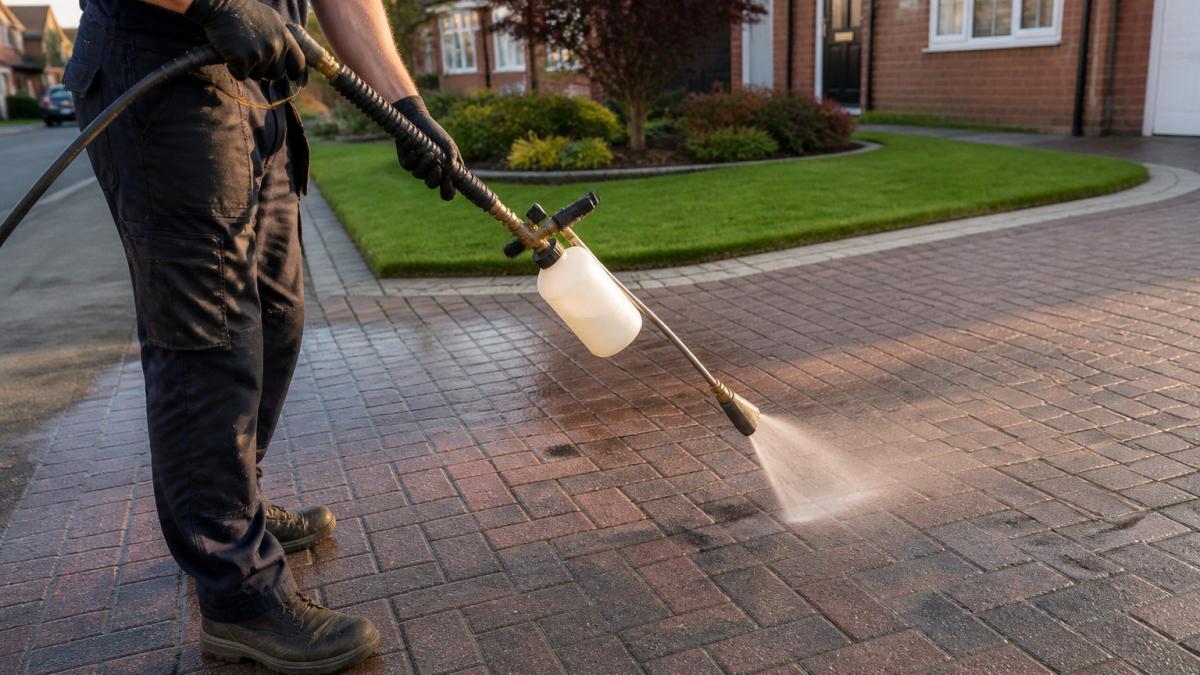
!A technician in work clothing applying a low-pressure solution with a hand-held applicator across a block-paved driveway in a residential street in Bolton, with a tidy front garden visible beside it
Step 1: Assess the Surface and Growth
The first step is an inspection. The technician checks the material, the level of algae or moss, and any staining. This decides the solution, the strength and how long it needs to work.
Look out for signs such as:
- Green or black algae on the surface
- Moss in the joints between pavers
- Oil or rust marks that need separate treatment
- Loose or damaged areas that need attention first
Step 2: Apply the Solution and Allow Dwell Time
The solution is applied evenly across the drive. Then it is left to work for a set period, called dwell time. During this time the growth is killed and begins to loosen.
Dwell time matters more than pressure. Rushing this stage leaves growth behind. Trying to shorten it by scrubbing or using more force often damages the surface without improving results.
Step 3: Rinse Away Loosened Growth
Once the dwell time is complete, the area is rinsed with clean water. The loosened algae, moss and grime wash away. Any remaining stains are then treated separately if needed.
A good rinse covers the whole surface evenly, with no streaks or residue left in the joints.
The process follows three stages, each with its own job and timing, as summarised below.
