
Absolutely. Here’s a cleaner, more natural blog-ready version that keeps the SEO value but reads like a genuine expert wrote it rather than a keyword page.
Recommended URL slug: `driveway-cleaning-cheshire`
SEO title: Driveway Cleaning Cheshire | Professional Cleaning & Restoration
Meta description: Professional driveway cleaning across Cheshire, including Warrington, Chester, Knutsford, Wilmslow and Alderley Edge. Block paving, concrete, tarmac and more.
Driveway Cleaning in Cheshire: What a Professional Clean Should Actually Involve
A green film across block paving, black spotting on a patio-style driveway or weeds pushing through the joints can make the front of a property look neglected long before the house itself does.
Professional driveway cleaning in Cheshire should involve more than simply turning up with a pressure washer and blasting the surface.
The right approach depends on what the driveway is made from, what is causing the staining or growth, the condition of the paving and what result can realistically be achieved.
At Refresh Revive Exterior Cleaning, we are based in Bolton and provide professional driveway cleaning across Cheshire and surrounding areas, including Warrington, Chester, Knutsford, Wilmslow and Alderley Edge.
Our approach is simple: assess the surface first and then choose the cleaning method to suit it.
Maximum pressure is not always the answer.
Why have your driveway professionally cleaned?
For many homeowners, appearance is the first reason.
A freshly cleaned driveway can completely change how the front of a property looks. Moss, weeds, algae, dirt and staining can gradually build up until you almost stop noticing how weathered the driveway has become.
But driveway cleaning isn't only cosmetic.
Moss and algae can make some surfaces slippery, particularly during wet weather. The Royal Horticultural Society also highlights how algae, lichens and mosses commonly establish on paths, patios and other hard surfaces.
We recently attended a property where the homeowner wanted a quotation after his young daughter had slipped on the driveway and grazed her knee.
That's a good example of why exterior cleaning can sometimes be about safety as well as appearance.
Why we don't simply jet wash every driveway
One of the biggest differences between professional driveway cleaning and basic DIY pressure washing is knowing when pressure alone isn't enough.
Dirt and organic growth can become embedded within textured paving.
Think of the surface almost like a piece of sandpaper. Dirt can sit down within the texture rather than simply resting on the top.
Increasing the pressure doesn't necessarily solve that problem.
Depending on what we find, we may use an appropriate professional treatment to help loosen organic contamination before cleaning the surface.
Our aim isn't to use as much pressure as possible.
It's to use the right combination of treatment, equipment, pressure and technique for that particular driveway.
Find out more about our driveway cleaning process.
The cleaning method depends on the surface
There isn't one method that works safely on every driveway.
That's why identifying the surface is one of the first things we do.
Block paving
Block paving generally responds very well to professional cleaning, but it needs to be cleaned properly.
Moss, weeds and dirt often gather within the sand-filled joints as well as on the surface of the blocks.
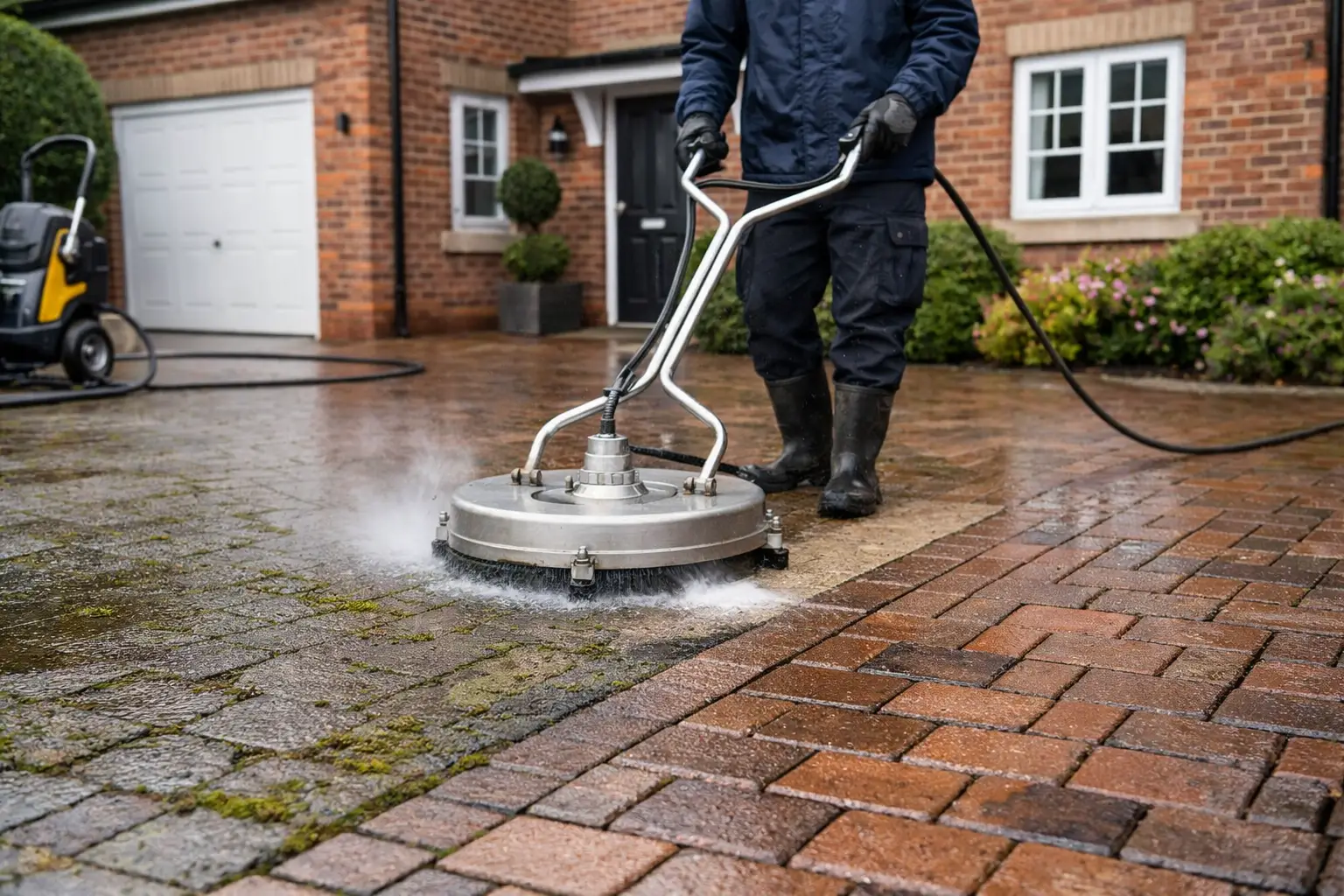
Where appropriate, we can use a professional surface cleaner that covers a much wider area than a standard pressure-washer fan.
By overlapping each pass, we can achieve much more even coverage and reduce the risk of leaving obvious cleaning lines across the driveway.
Cleaning block paving will also remove some of the existing jointing sand.
That's why re-sanding is normally considered part of the process rather than an afterthought.
Once the paving has dried sufficiently, kiln-dried sand can be swept back into the joints to help restore them.
Re-sanding can also help reduce the opportunity for weeds to establish, although no cleaning or re-sanding process can guarantee that weeds will never return.
Indian sandstone and natural stone
Natural stone needs judgement.
One of the most common DIY problems we see is pressure-washer striping.
If you've ever seen sandstone covered in light and dark lines after somebody has cleaned it themselves, you've probably seen exactly what we mean.
The fan from a pressure washer can leave visible lines where the lance has been held too close to the surface or moved unevenly.
A driveway or patio can therefore technically be cleaner but actually look worse than it did before it was washed.
These marks can often be improved by cleaning the surface again using the correct technique and more even coverage.
However, natural stone varies considerably, so we assess it before deciding how it should be treated.
Tarmac and asphalt driveways
Tarmac requires a more restrained approach.
Aggressive pressure washing can potentially affect an older or weathered surface, particularly where the material is already beginning to deteriorate.
Cleaning may significantly improve algae, dirt and general surface contamination, but it cannot repair cracks, loose material or deterioration within the driveway itself.
Sometimes professional knowledge means knowing when not to pressure wash something.
Concrete and imprinted concrete
Concrete can collect tyre marks, organic growth, dirt and black staining, particularly in shaded areas.
Plain concrete can often tolerate professional cleaning well, but age and condition still matter.
Imprinted concrete requires additional consideration because it may have colouring or a previous protective coating.
If a surface has been sealed previously, we need to consider the condition of that coating before deciding how aggressively it should be cleaned.
Resin-bound driveways
Resin-bound driveways shouldn't automatically be treated like block paving.
They can develop algae, moss and traffic grime, particularly around shaded areas and edges, but a lower-pressure method may sometimes be more appropriate.
Cleaning can improve surface contamination, but it cannot repair loose resin, physical deterioration or permanent UV-related colour changes.
Again, the aim is improvement rather than making unrealistic promises.
Why moss, algae, lichen and weeds need different treatment
Not every green or black mark on paving is the same thing.
A homeowner might describe everything as moss, but there can be several different types of contamination present.
Algae
Algae can create a green or darker film across the surface and may become slippery when wet.
Moss
Moss commonly establishes around edges, between joints and in damp shaded areas.
Lichen and black spotting
Lichen can attach much more firmly to the paving and may require appropriate treatment rather than relying on water pressure alone.
Weeds
Weeds commonly establish within the joints of block paving.
Cleaning removes existing growth and debris, while re-sanding afterwards helps restore the joints.
The RHS also provides useful guidance on why weeds establish on hard surfaces such as paths, paving and driveways.
What about oil stains?
Oil is one of the areas where customers need realistic expectations.
A fresh oil spill may respond considerably better than a stain that has been soaking into porous concrete or block paving for months or years.
Once contamination has penetrated deeply into a porous surface, complete removal may not always be possible.
We would rather explain that before starting than promise somebody their driveway will look brand new and disappoint them afterwards.
That principle applies to all exterior cleaning:
We'd rather tell you honestly what can and can't be achieved before we start than promise you a perfect result just to win the job.
Test patches and professional assessment
Another important part of professional exterior cleaning is knowing how a surface will react before committing to the whole area.
Where appropriate, we may carry out a small test patch in a less noticeable part of the driveway before applying a treatment more widely.
We also look for existing issues such as:
- crumbling or frost-damaged brickwork
- loose or badly damaged pointing
- unstable paving
- failing concrete
- previous sealers or coatings
- drainage problems
- damaged edging
- heavily weathered natural stone