Last Updated: November 16, 2026
Quick Summary
Safety standards for professional exterior property cleaning are the legal duties and safe working procedures a contractor must follow before, during and after any job. In the UK these are set by the Health and Safety at Work etc. Act 1974, the Work at Height Regulations 2005, COSHH and PUWER.
- Ask for a site-specific risk assessment and method statement, not a generic template with the address swapped.
- Request public liability insurance, employers' liability insurance and COSHH assessments before any contractor sets foot on site.
- Pure water window cleaning can be carried out from ground level, so ladders are not needed for many domestic and low-rise windows.
- Control and direct cleaning run-off away from surface water drains, as letting chemical-laden water flow into them can breach environmental rules.
- A RAMS that names no supervisor and lists no site-specific hazards is a red flag; ask for it to be revised before work starts.
Table of Contents
- What Safety Standards Apply to Professional Exterior Property Cleaning?
- Building an Exterior Cleaning Risk Assessment That Holds Up
- Commercial Exterior Cleaning RAMS: What Property Managers Should Expect
- COSHH for Exterior Cleaning: Chemicals, Run-off and Drainage
- Working at Height Window Cleaning Without the Guesswork
- Matching the Method to the Surface to Prevent Damage
- Protecting Pedestrians, Occupants and Visitors on Occupied Sites
- Slips, Trips and Algae: Controlling the Risk You Leave Behind
- How to Verify a Contractor's Competence and Insurance
- Requesting a Quote and Pre-Visit Assessment
- Frequently Asked Questions
What Safety Standards Apply to Professional Exterior Property Cleaning?
Safety standards for professional exterior property cleaning are the legal duties and safe working procedures a contractor must follow before, during and after any job. In the UK, that means the Health and Safety at Work etc. Act 1974, the Work at Height Regulations 2005, COSHH and PUWER.
The core idea is simple. A contractor owes a duty of care to their own staff, to you, and to anyone passing by. That duty applies whether the job is a driveway in Horwich or a retail park in Lancashire.
Below, we break down exactly what those standards look like in practice. You will see what to ask for, what to check, and what a competent contractor should hand over before work starts.
The regulations that actually govern the work
Four pieces of UK law sit behind almost every exterior cleaning job:
- Health and Safety at Work etc. Act 1974 sets the general duty to protect workers and others affected by the work.
- Work at Height Regulations 2005 cover any task where someone could fall and injure themselves, including gutter clearing and window cleaning.
- COSHH 2002 governs how cleaning chemicals are assessed, stored and used.
- PUWER 1998 requires that pressure washers, lances and access equipment are suitable, inspected and maintained.
These are not box-ticking exercises. They shape how a job is planned, who does it, and what equipment is used.
Why method choice is a safety decision, not just a finish
Blasting a render wall at full pressure is not just a risk to the surface. It throws debris, destabilises loose material and can send fragments towards people nearby. Low-pressure soft washing reduces that risk while still cleaning properly.
That is why we match the method to the surface rather than reaching for maximum pressure. You can see how that works in practice on our soft washing service across Bolton and the North West. If you want the full comparison of methods, read our guide to soft washing versus pressure washing.
Building an Exterior Cleaning Risk Assessment That Holds Up
An exterior cleaning risk assessment is a written record of what could go wrong on a specific job and how the contractor will control it. It should be site-specific, not a generic template with the address swapped. For property managers, the most useful version is one you can actually check before the van arrives.
A risk assessment that holds up covers five things:
- Hazards identified for that property, from algae-covered paving to overhead cables and fragile roof lights
- Who is at risk, including staff, occupants, visitors, contractors and the public
- Control measures for each hazard, in order of priority
- Residual risk after controls are applied
- Review date and responsible person
A common mistake is treating the risk assessment as paperwork to file away. In practice, it should drive the plan for the day. If the assessment says the patio is slippery when wet, then barriers and signage go up before the first drop of water lands.
A practical pre-job checklist for property managers
Use this to sanity-check any exterior cleaning contractor before work starts. It turns general compliance advice into something you can hold in your hand.
Contractor documents
- Site-specific risk assessment and method statement (RAMS) for this job, not a generic template
- Public liability insurance certificate, in date
- Employers' liability insurance if they employ staff
- COSHH assessments for every chemical they will use
- Training evidence for work at height and equipment use
- A named site supervisor and a contact number for the day
Site access and public protection
- Agreed access routes, parking and delivery timings
- Barriers and warning signs planned for wet or active areas
- Pedestrian diversions or temporary walkways where needed
- Vehicle movements agreed so cleaning vehicles do not block fire routes or loading bays
- Confirmation of which areas will be out of bounds and for how long
Emergency arrangements
- First-aid arrangements and nearest A&E confirmed
- Spill kit on site for any chemicals used
- Emergency contact for the site and for the contractor
- Plan for sudden weather changes, especially wind and rain on high-reach work
Handover
- Confirmation of which surfaces are still wet and when they can be reopened
- Debris and dislodged moss removed, not just washed around
- Any damage or snagging reported before the contractor leaves
Watch out: a RAMS that names no supervisor and lists no site-specific hazards is a red flag. Ask for it to be revised before work starts.
Commercial Exterior Cleaning RAMS: What Property Managers Should Expect
Commercial exterior cleaning RAMS means Risk Assessment and Method Statement: a combined document that sets out the hazards and the safe working procedure step by step. For facilities and property managers, it is the single most useful document to request.
The method statement should describe the sequence of work, the equipment, the access arrangements, the chemicals, the controls, and the emergency arrangements.
Documents to request before the first visit
Ask for these before any contractor sets foot on site:
- Risk assessment and method statement for the specific job
- Public liability insurance certificate
- Employers' liability insurance if they employ staff
- COSHH assessments for any chemicals used
- Evidence of training for work at height and equipment use
- A named site supervisor and contact number
COSHH for Exterior Cleaning: Chemicals, Run-off and Drainage
COSHH for exterior cleaning means assessing every substance used, understanding its hazards, and controlling exposure to workers and the environment (Control of Substances Hazardous to Health (COSHH)). That includes the cleaning solutions, the run-off they create, and where that water ends up.
Most exterior cleaning run-off is not harmless. It carries dirt, algae, moss and traces of cleaning product. On a commercial site, that water should be controlled and directed away from drains that lead to watercourses.
If you want to compare gentler product options for gardens and patios, our guide to eco-friendly cleaners for patio and garden safety is a good starting point.
Watch out: letting chemical-laden run-off flow into a surface water drain can breach environmental rules and land the site owner with a problem. Contain it first.
Working at Height Window Cleaning Without the Guesswork
Working at height window cleaning is any window cleaning where a person could fall and be injured. The Work at Height Regulations require that work is avoided at height where possible, and where it cannot be avoided, that it is properly planned and uses suitable equipment (Assessing all work at height). The same logic applies to gutter clearing, roof moss removal and fascia cleaning, which is why we plan all high-level work together rather than treating window cleaning as a separate job.
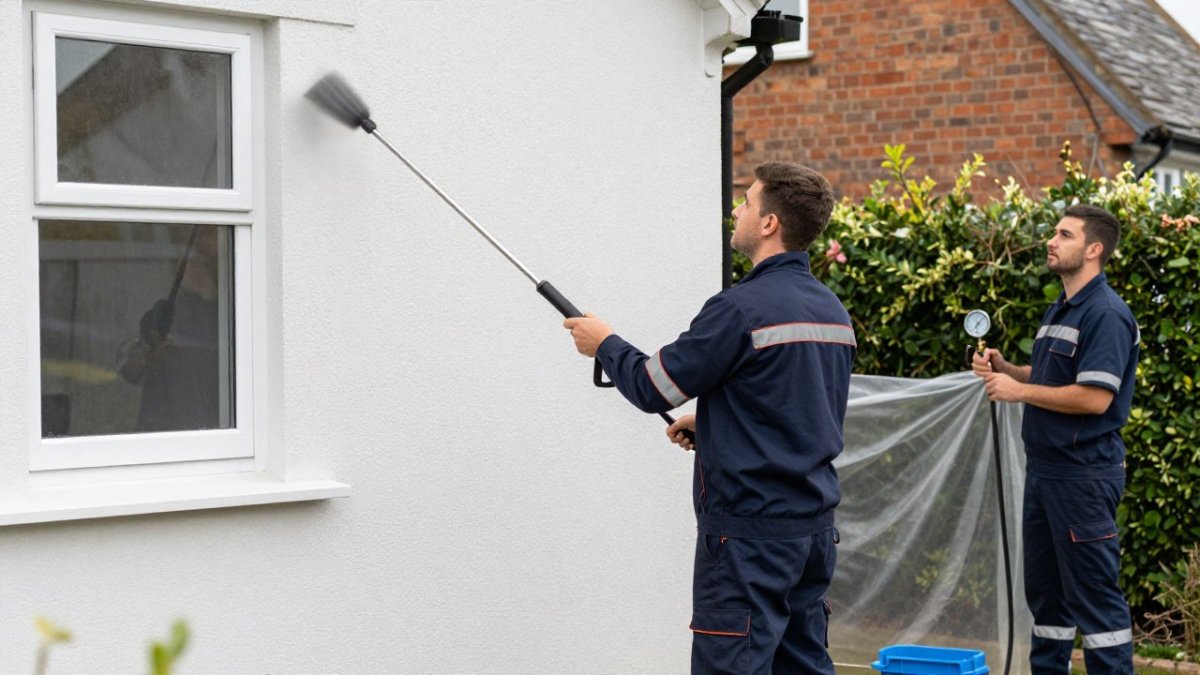
For most domestic and low-rise commercial windows, the safest approach is to avoid ladders altogether. Pure water window cleaning can be carried out from ground level, so ladders and platforms are not needed for many domestic and low-rise windows.
Where higher access is genuinely needed, the planning changes:
- Ladders only for short-duration, low-risk tasks on firm level ground
- Mobile elevating work platforms for taller or longer jobs
- Trained, competent operators for any powered access equipment
- Equipment inspected before every use
- Roof work planned around fragile surfaces such as roof lights and old tiles
High-reach work beyond windows
Gutter clearing, roof moss removal and fascia and soffit cleaning all involve work at height, but they carry different risks. Gutters may be blocked and heavy, roof tiles may be fragile, and fascia boards may be loose. We plan each one on its own terms: