

Last Updated: November 10, 2026
Quick Summary
A long-term exterior property maintenance budget spreads the cost of upkeep across the year, so surfaces are protected before small problems become expensive repairs. Start by surveying every exterior element, then build an annual checklist, price each task and set aside a repair reserve for urgent work.
- Walk the property and list every exterior element, from roof and gutters to driveway and boundary walls.
- Build an annual checklist with seasonal tasks such as spring render checks and autumn gutter clearing.
- Compare professional quotes against DIY, and leave roof work and gutter clearing at height to qualified teams.
- Build a repair reserve for urgent work, aiming to cover at least one unexpected repair per year.
- Review the budget every year using fresh quotes for a sample task to account for rising costs.
Table of Contents
- Why an Exterior Maintenance Budget Protects Your Property Value
- Step 1: Survey Your Property and List Every Exterior Element
- Step 2: Build an Annual Exterior Property Maintenance Checklist
- Step 3: Set Your Exterior Cleaning Frequency Guide for Lancashire Weather
- Step 4: Price Each Task and Compare Professional Against DIY Costs
- Step 5: Protect Render and Learn How to Prevent Render Staining
- Step 6: Prioritise Repairs and Build an Emergency Repair Reserve
- Step 7: Adjust Your Budget for Inflation and Property Age
- Common Budgeting Mistakes That Cost Property Owners More
- Booking Your First Professional Exterior Assessment
- Frequently Asked Questions
Why an Exterior Maintenance Budget Protects Your Property Value
Planning a long-term exterior property maintenance budget is one of the simplest ways to protect what your home or business is worth. Exterior surfaces take the full force of Lancashire weather, from driving rain to damp winters and algae-friendly humidity. Without a plan, small problems turn into expensive ones.
Refresh Revive Exterior Cleaning works with homeowners, landlords and commercial property managers across Bolton and the wider North West. We see the same pattern again and again. A blocked gutter overflows, water runs down the render, and a stain that could have been cleaned in an afternoon becomes a repair job.
Your exterior is the first thing visitors notice. A clean driveway, healthy render and clear gutters all signal a well-kept property. Neglect signals the opposite, and it can affect how buyers, tenants and customers see you.
A written budget turns vague good intentions into a plan. It lets you spread costs across the year instead of facing them all at once.
- Protects surfaces before damage becomes structural
- Keeps running costs predictable
- Makes it easier to justify spending to a landlord, board or partner
- Gives you time to compare quotes instead of rushing into emergency work
Step 1: Survey Your Property and List Every Exterior Element
Start by walking the outside of your property with a notepad or a simple spreadsheet. Note every surface that needs regular attention. Most owners forget at least a few items on their first pass.
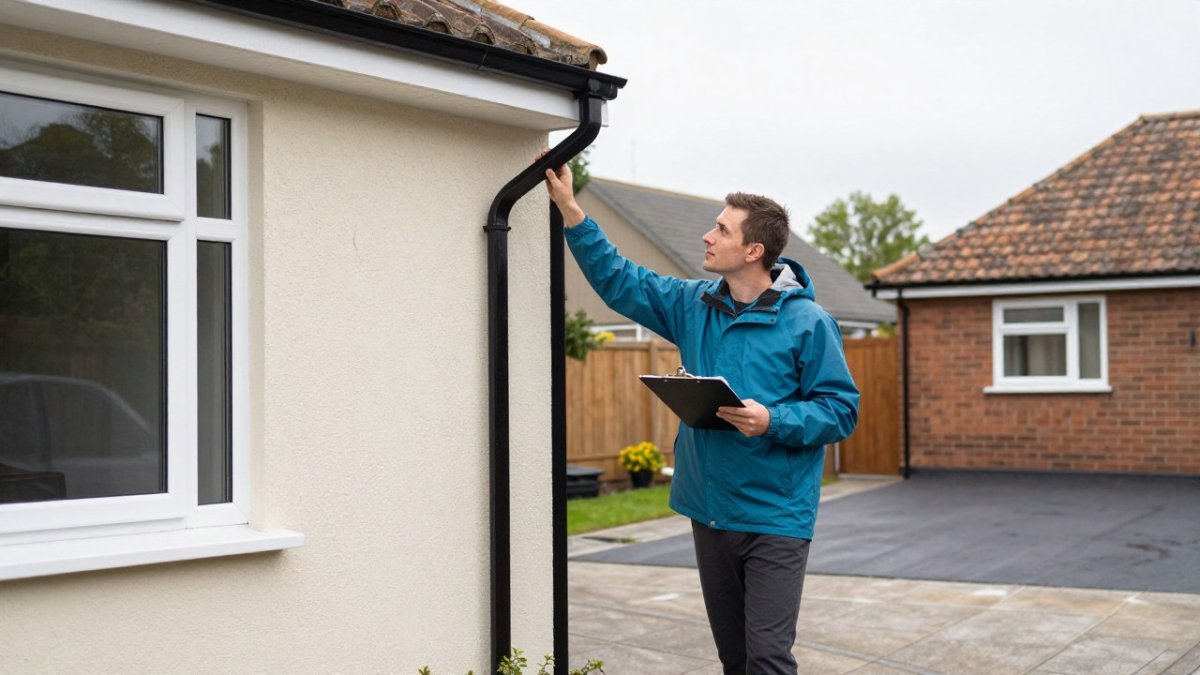
Here is what to include:
- Roof, including tiles, ridges and visible moss growth
- Gutters, downpipes, fascias and soffits
- Walls, render, brickwork and pointing
- Windows, frames and any conservatory roof
- Driveway, patio, paths and decking
- Boundary walls, fences and gates
- Garage doors and external sheds
Take photos as you go. A dated photo makes it much easier to track change over time, and it gives a contractor a clear starting point when you request a quote.
Watch out: Do not climb ladders or walk on fragile roofs to complete your survey. Use binoculars, a camera zoom or a professional inspection instead.
Once you have your list, note the material of each surface and its condition on a simple scale: good, fair or poor.
Step 2: Build an Annual Exterior Property Maintenance Checklist
An annual exterior property maintenance checklist turns your survey into a repeatable routine. It should cover what to inspect, what to clean and what to repair, month by month or season by season.
A practical checklist for most UK properties looks like this:
- Spring: Inspect render and walls for staining, check gutters after winter, clear debris from drains
- Summer: Clean driveways, patios and decking, check window seals and external paintwork
- Autumn: Clear leaves from gutters and roofs, check downpipes and drainage outlets
- Winter: Look for leaks, damp patches and cracked paving after frost
Keep the checklist on your phone or in a shared folder so everyone responsible for the property can see it.
Step 3: Set Your Exterior Cleaning Frequency Guide for Lancashire Weather
Cleaning frequency depends on your surfaces, your trees and how exposed your site is. A property on a shaded, damp plot needs more attention than one on an open, sunny road.
As a general guide, many owners find that driveways and paths benefit from cleaning once or twice a year, while gutters are best cleared at least twice a year and more often if trees overhang the roof. Render often needs attention every year or two, depending on algae and staining.
Watch for these signs that a surface needs cleaning sooner:
- Green or black algae on walls, paths or the north side of the building
- Slippery patches on paving or driveways
- Moss growing between paving slabs or along roof edges
- Water running over gutters during rain
Our approach is to match the method to the surface. Soft washing is generally suited to render and painted walls, because it cleans at low pressure. Professional pressure washing can suit many driveways and patios. For roofs, aggressive high-pressure washing is best avoided, and moss removal should protect the tiles.
If you want a clear schedule for your property, we are happy to assess it from photographs and recommend a frequency that fits your surfaces and your location.
Step 4: Price Each Task and Compare Professional Against DIY Costs
Once you have your checklist, the next job is to work out what each task is likely to cost you, and whether doing it yourself genuinely saves money. Many owners assume DIY is always cheaper. In practice, it depends on the task, the height and access, the surface, and what a mistake would cost to put right.
When we talk to homeowners and landlords across Bolton and the wider North West, the same split comes up again and again. Some jobs are sensible to tackle yourself. Others carry enough risk, to you or to the building, that a qualified professional is the better value.
Tasks you can realistically do yourself
A number of routine tasks are within reach of a reasonably confident homeowner with the right kit:
- Clearing leaves and debris from accessible gutters on a single-storey extension, using a long-handled gutter scoop from the ground or a secure first-floor window
- Sweeping and light surface cleaning of patios and paths, with a stiff brush and a suitable detergent
- Checking the property for staining, loose fixings, damp patches and cracked pointing, using binoculars or a camera zoom
- Clearing drain gratings and downpipe outlets of leaves and silt
- Hosing down render to remove loose dust before any deeper cleaning
The saving here is real, mostly in the cost of your own time and a few inexpensive tools. Keep your expectations realistic, though. A hose and brush will not remove algae or ingrained staining from render, and it will not treat moss on a roof.
Tasks that need a certified professional
Some tasks carry a risk that outweighs the saving:
- Roof work and moss removal. Walking a roof is dangerous, and high-pressure washing can lift and crack tiles and push water under the covering. Moss removal should use a treatment method that protects the tiles.
- Gutter clearing at height, particularly on two storeys or more. Falls from ladders are a serious and common cause of injury (Safe use of ladders and stepladders).
- Soft washing of render and painted walls. The right cleaning solution, dwell time and low-pressure technique are hard to judge without training, and the wrong approach can strip the finish.
- Driveway and block paving cleaning with powered equipment. Excess pressure or the wrong chemical can etch the surface, dislodge jointing sand and leave permanent marks.
- Anything involving commercial access, working near occupied buildings, or specialist waste handling.
Watch out: a cheap DIY job that damages a surface often costs more to repair than the professional job would have cost in the first place.
What a professional quote should include
When comparing quotes for the tasks you have set aside, look beyond the headline figure. A fair quote normally makes clear:
- The method to be used for each surface, and why it suits that surface
- Access arrangements, including any ladders, platforms or equipment needed to reach the work
- Whether waste removal and water supply are included
- Whether a follow-up visit or a touch-up is covered
- Any conditions, such as the need for dry weather or access to an outside tap
A lower quote that skips the method explanation or the access assessment can leave you with a bigger bill later.
Building your own cost comparison
For each task on your checklist, record three figures: the materials or hire cost if you do it yourself, the professional quote, and an honest estimate of your own time. Add a note on the risk level, from low to high. This gives you a practical basis for deciding where to spend, rather than choosing on price alone.
If you would like a second opinion on which tasks suit DIY and which need a professional, send us photographs of your gutters, roof edges, render and paving. We will tell you plainly what we would tackle ourselves and what we would recommend leaving to a qualified team.
The table below sets out which routine tasks suit a confident DIY approach and which carry enough risk to justify a qualified professional.
| Task | Suited to | Key consideration |
|---|---|---|
| Clearing accessible gutters | DIY | Use a long-handled scoop from the ground or a secure window |
| Sweeping patios and paths | DIY | Stiff brush and suitable detergent |
| Roof work and moss removal | Professional | Walking roofs is dangerous; high pressure can lift tiles |
| Gutter clearing at height | Professional | Falls from ladders are a serious, common injury |
| Soft washing render | Professional | Wrong solution or dwell time can strip the finish |
| Powered driveway cleaning | Professional | Excess pressure can etch the surface and dislodge jointing sand |
Step 5: Protect Render and Learn How to Prevent Render Staining
Render is one of the most common surfaces we treat, and it is also one of the easiest to damage. Dark green or black staining usually comes from algae, fungi or moisture that stays on the wall for long periods.
To help prevent render staining:
- Fix blocked or leaking gutters and downpipes quickly
- Keep soil and plant beds away from the base of the wall
- Trim overhanging branches that keep the surface damp
- Clean the render at the right frequency to stop build-up
- Consider a protective coating after professional cleaning, where suitable
Avoid high-pressure jet washing on render. It can break the surface, force water behind the finish and create new problems. Soft washing with an appropriate cleaning solution is far gentler and removes staining without stripping the render.
If your render is already stained, book an assessment before choosing a method. The right approach depends on the type of render and how deep the staining goes.
