
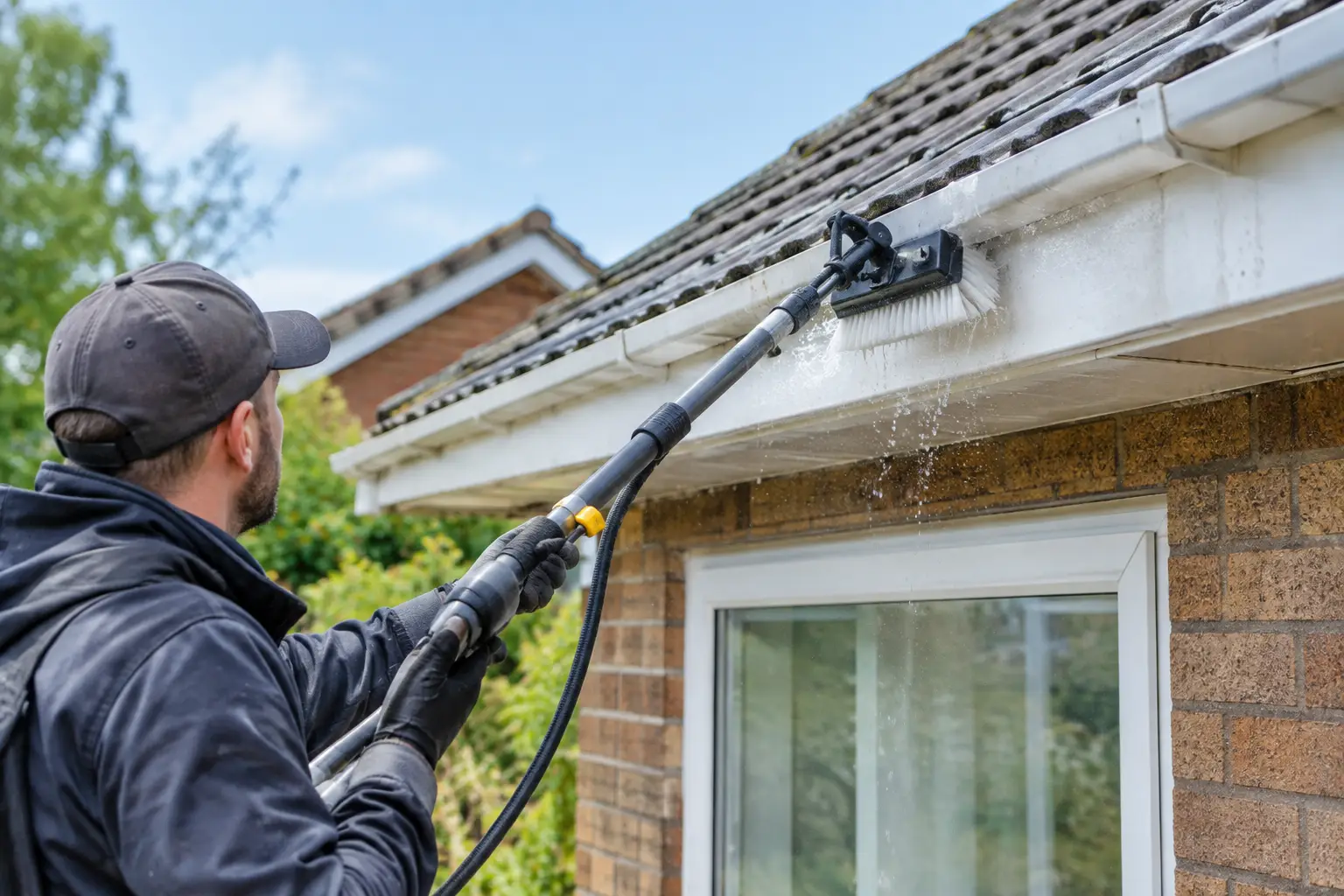
A grey-green line beneath the guttering can make an otherwise tidy property look neglected. Fascia cleaning removes the traffic film, algae, dust and weather staining that build up on fascia boards, soffits and the edges around guttering. Done with the right method, it can brighten the roofline without treating these fitted surfaces as if they were paving.
For homeowners, landlords and property managers, the point is practical as much as visual. A clean roofline improves the overall presentation of a property, while the cleaning process gives a clearer view of areas that may need separate maintenance, such as damaged seals, loose guttering or deteriorating boards.
What fascia cleaning covers
Fascias are the long boards fixed at the lower edge of a roof, usually directly behind the guttering. Soffits are the horizontal panels beneath them. Together, they frame the roofline and are often made from uPVC, although some older properties have painted timber or other materials.
Because they sit high on the building, fascia boards can collect a surprising amount of grime. Rainwater splashes, airborne dirt, cobwebs and algae all settle on sheltered edges. On busier roads, traffic film can leave a dull finish. North-facing elevations and shaded areas are more likely to show green growth or darker staining, particularly where moisture lingers around the gutters.
A professional clean usually includes the visible faces of fascia boards and soffits, along with accessible exterior gutter surfaces and associated roofline trim where appropriate. The exact scope should be agreed after looking at the property. Conservatories, window frames and cladding may also need attention, but they are separate surfaces and should not simply be assumed to be included.
Why the cleaning method matters
Fascia boards are not a surface for aggressive pressure washing. High pressure used too closely can force water behind joints, disturb seals or mark older painted finishes. It may also drive debris into vents or vulnerable gaps around the roofline.
The sensible approach depends on the material, the level of contamination and access. Light surface dirt may respond to a controlled low-pressure rinse and suitable cleaning treatment. More established algae or ingrained grime may need a longer dwell period and careful agitation before rinsing. Pure-water cleaning may be appropriate for some finishing work on accessible uPVC surfaces, particularly where a clear, spot-free rinse is required.
At Refresh & Revive Exterior Cleaning, methods are selected for the surface and its condition rather than applying one approach to every job. Commercial equipment, including hot-water capability where suitable, has a place in exterior cleaning, but the available power is not the same as the power that should be used on a fascia board. Careful control is what matters at roofline level.
uPVC fascias and soffits
Most modern rooflines use uPVC. These boards are hard-wearing, but they can still become dull through oxidation, atmospheric dirt and biological growth. A gentle but thorough clean can improve their appearance considerably when the discolouration is on the surface.
There are limits. Deep yellowing, fading from sunlight, scratches, failed protective finishes or staining within the material may not clean away completely. Cleaning removes contamination; it does not make aged uPVC new again.
Painted timber and older rooflines
Painted timber needs more caution. Loose paint, open joints, soft wood and flaking finishes can be made worse by excessive water or pressure. In these cases, cleaning may be limited to a cautious surface treatment, or it may be more sensible to address repair and repainting first.
A clean is also not a repair service. If a fascia is rotten, bowed or pulling away from the roof edge, that is a maintenance issue requiring the appropriate trade. The same applies to leaking gutter joints, damaged downpipes and defective roof tiles.
Fascia cleaning and gutter clearing are different jobs
It is easy to confuse dirty fascia boards with a gutter problem, but they are not the same. Fascia cleaning focuses on the outer, visible roofline surfaces. Gutter clearing removes leaves, moss, silt and other debris from inside the gutter channel so rainwater can flow towards the downpipe.
Many properties need both services, especially after periods of heavy leaf fall or where moss from the roof has washed into the gutters. Clearing the gutters can reduce overflowing water, while cleaning the outer fascia and soffit surfaces improves the finish seen from the ground. One does not automatically solve the other.
Before arranging work, look for overflow marks, vegetation growing from gutters, damp streaking beneath joints, or water running over the front edge during rain. These signs suggest the gutter system should be assessed as well as the fascia boards.