
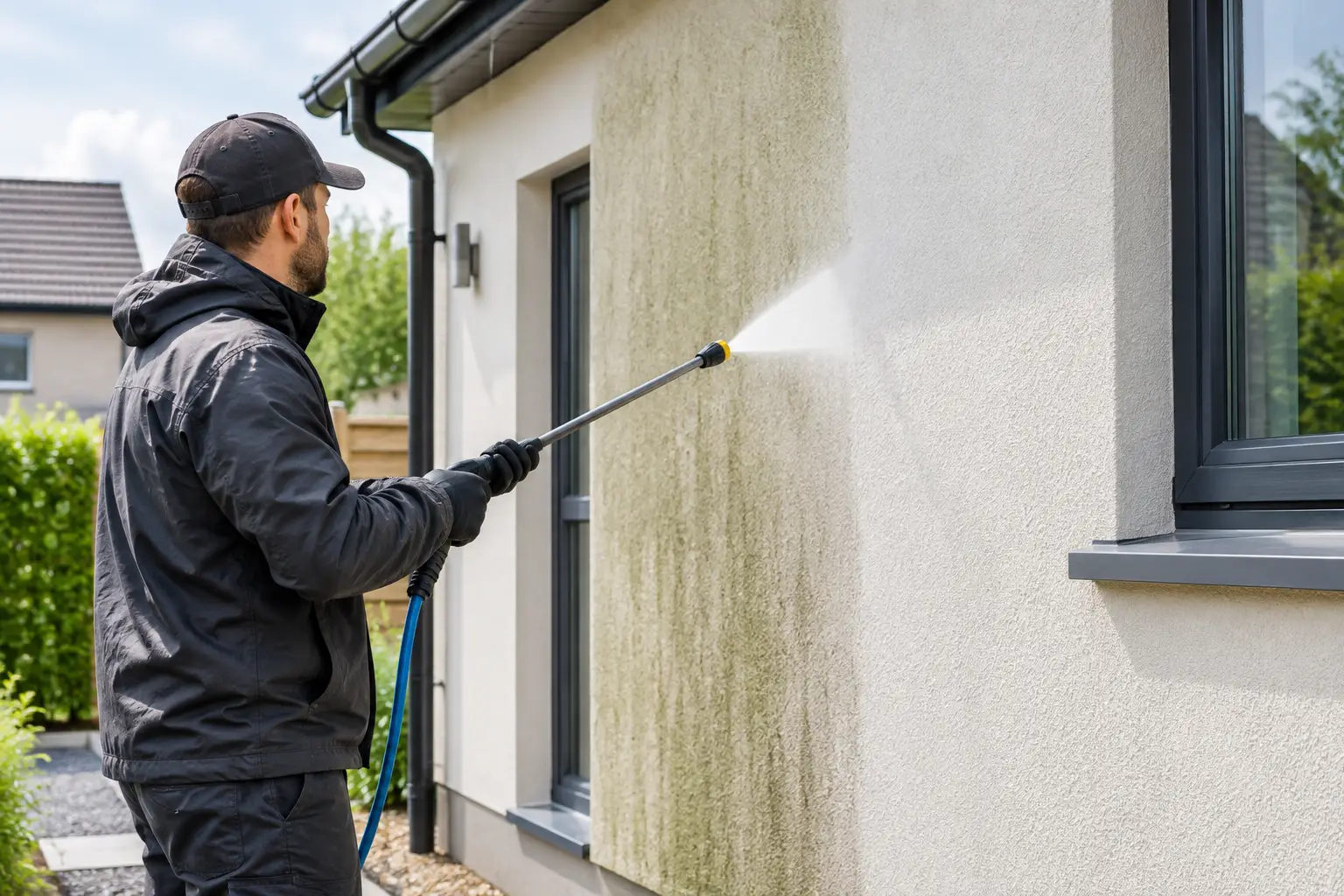
Green streaks below window sills, black spotting on sheltered walls and dull-looking patches can make an otherwise well-kept property look tired. Knowing how to clean silicone render starts with recognising that this is not a surface for aggressive pressure washing. Silicone render has a textured, water-repellent finish, and the wrong method can leave marks, disturb the surface or create an uneven result.
For most homes, a controlled low-pressure treatment with a suitable cleaning solution is the sensible approach. The aim is to treat the organic growth causing the discolouration, then rinse carefully where appropriate - not to blast the wall clean at high pressure.
Why silicone render becomes stained
Silicone render is designed as a breathable external finish with water-repellent properties. Rainwater tends to bead and run off rather than soak in, but that does not stop dirt, airborne pollution and organic matter settling on the surface.
Algae is one of the most common causes of green discolouration, particularly on north-facing elevations, shaded walls and areas beneath trees. Moss and lichen may also develop where a wall stays damp for longer. Black spots can be organic growth, but they can also be linked to general atmospheric soiling or water repeatedly running over the same area.
The source of the problem matters. A wall close to overflowing gutters, leaking pipework, a blocked gully or dense planting may continue to become dirty quickly if the moisture issue is not addressed. Cleaning improves the appearance, but it cannot correct a drainage or maintenance fault elsewhere on the property.
How to clean silicone render safely
Start by checking the condition of the render. Look for cracks, loose sections, failed sealant around openings, exposed edges and any areas where the finish is already breaking down. These defects need consideration before cleaning, as water and treatment solutions can enter behind a compromised surface.
Remove loose cobwebs and dry debris gently with a soft brush. Avoid abrasive pads, wire brushes and vigorous scrubbing, which can alter the render texture and leave visibly cleaner patches. Protect nearby planting, garden furniture and any surface that could be affected by run-off before applying a cleaning treatment.
A purpose-made render cleaner or biocidal treatment is commonly used to deal with algae, moss and lichen. It should be selected and diluted in line with the product instructions and used only where it is appropriate for silicone render. Application is normally controlled with low-pressure equipment, allowing the treatment to reach the contamination without forcing water into the wall.
The cleaner needs sufficient contact time to work. Rushing this stage is a common reason people turn to excessive pressure afterwards. Depending on the treatment, condition of the wall and the manufacturer guidance, the surface may be gently rinsed or left for natural weathering to carry away treated organic matter over time.
Always test a small, unobtrusive section first. Render systems differ in age, texture, colour and previous treatment, so there is no single setting or chemical mix that suits every property. If the test produces a change in colour, texture or finish, stop and seek specialist advice.
Why high-pressure washing is usually the wrong choice
Commercial pressure-washing equipment is highly effective on suitable hard surfaces such as some paving, driveways and walls. Silicone render is different. Direct high pressure can scar the textured finish, force water into joints and weak points, or leave striping that becomes more obvious as the wall dries.
Even when a wall looks clean immediately after aggressive washing, the finish may have been unnecessarily disturbed. A lower-pressure, treatment-led method takes more judgement, but it is generally better suited to a coated render surface with organic staining.
What not to use on silicone render
Household bleach, brick acid and strong acidic cleaners are poor starting points for a silicone-render wall. They may not be suitable for the coating, nearby materials or planting, and a harsh product does not necessarily solve the underlying organic growth.
Avoid painting over active algae or lichen simply to cover it up. The marks can reappear, and applying paint to a contaminated or damp surface can create further maintenance work. Steam cleaning and abrasive cleaning also need careful assessment rather than a blanket assumption that they will suit the render.
A domestic pressure washer used at close range is another frequent cause of avoidable problems. The fact that a machine has an adjustable nozzle does not make it appropriate for every external surface. Distance, pressure, nozzle type, water flow and the wall's condition all affect the outcome.
Dealing with stubborn algae, lichen and black marks
Established lichen often holds tightly to textured render. Trying to scrape it away can damage the finish, so treatment and patience are usually preferable to force. A suitable cleaner can address the growth, while weathering and gentle rinsing help improve the appearance without harsh mechanical action.